
















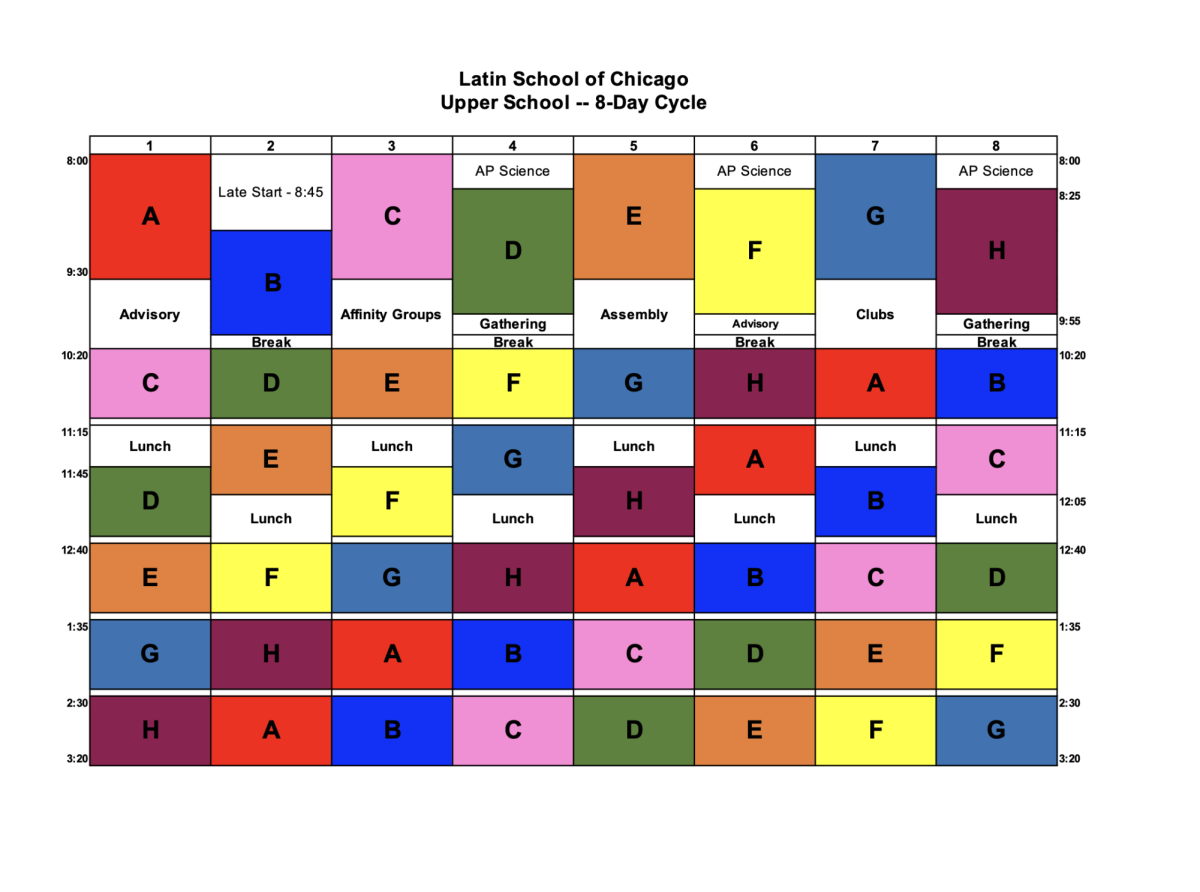




















Latin’s eight-day rotating schedule has drawn scrutiny from faculty, staff, students, and families. However, we believe the unique schedule significantly benefits the community, and a change would be detrimental.
Unlike the fixed schedule used by many Chicago high schools, where students begin and end at the same time each day, Latin’s schedule offers later starts, earlier dismissals, and free periods throughout the school day.
Through applications such as Google Calendar and Apple Calendar, students can easily see the exact times their various classes start. While a generic schedule with the same start time each day may be easier for students to remember, or make mornings for those who use public transit simpler, the benefits of the staggered start times outweigh the few inconveniences they present.
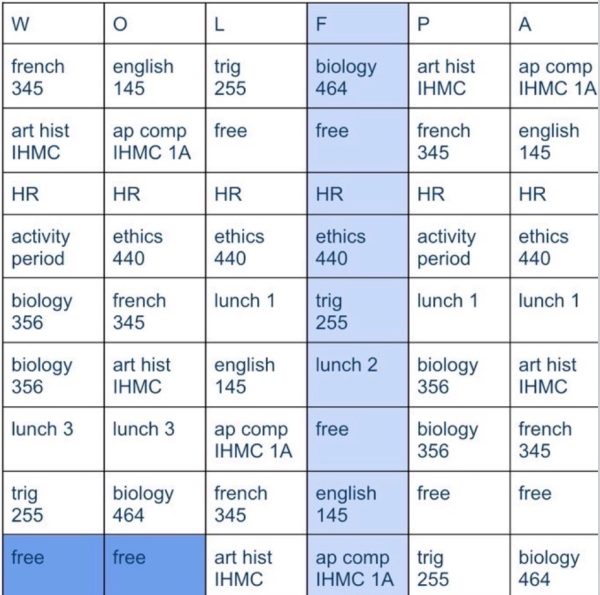
Research published by the National Library of Medicine shows that adolescents naturally tend toward later sleep and wake times. Many students also participate in extracurricular activities, which consume time before, after, and during school hours. These activities, paired with homework and studying, create a stressful after-school schedule that forces students into a condensed timeframe—one that a traditional, non-staggered school day cannot support. In Latin’s eight-day cycle, a student-athlete who ended practice late at night could have the opportunity to sleep in, finish leftover homework, and meet with a teacher during a long lunch.
Parents may argue that students solely use free periods for socializing, and although that is not the intended purpose of the valuable time, socializing is one of the most important parts of a student’s day. In fact, without socialization during school, students’ moods and academic motivation could suffer.
Still, parents’ concerns do not reflect the complete reality: students are often found across the school quietly studying during their free periods.
Frees are an essential way to break up long periods of time at school in order to maintain productivity and ensure that students feel supported and that their mental health is a priority. A 2021 National Institutes of Health research study concluded that breaks can advance memory formation and cognitive performance, and rest can strengthen memories and accelerate learning. These findings are particularly important at Latin, which prides itself on providing a rigorous college-preparatory education.
Large chunks of free time during the day also force students to exercise skills such as time management, emotional maturity, and self-advocacy. These skills are essential for building relationships beyond high school.
This focus on skill building directly reflects Latin’s values. Latin’s philosophy emphasizes college readiness, and our non-traditional approach to scheduling is one of many steps that the administration takes to prepare students for the next steps of their lives. In college, students may not have a uniform start or end to their school day. Instead, each day has different classes and time frames. Latin’s schedule intentionally simulates a college-level day, prioritizing independence and accountability.
To build community time into the school day, the schedule provides time once a cycle for student clubs and affinities to meet, thus encouraging students to engage in extracurricular activities. Giving students time during the school day alleviates stress from already packed after-school schedules.
Not everyone may like Latin’s eight-day rotation, but our precious late starts and free periods throughout the day should not be tinkered with. Although upon first glance the schedule may seem intimidating, the life lessons and flexibility that it provides for students are irreplaceable.
The eight-day schedule embodies academic success, personal growth, and responsibility. By allowing students to make informed decisions about how to spend their time, whether that means going to nearby Chipotle during long lunch or meeting with Upper School History Teacher Ernesto Cruz to polish a history essay, the schedule builds accountability and prepares students for college and adult life.
Instead of stripping Latin of the pillars that contribute to its independent, liberal arts education, we should celebrate our students’ high quality of life, all thanks to our flexible, student-prioritizing schedule.