“Teachers are born,” Upper School performing arts teacher Frances Limoncelli said. “There are people, even if they don’t work as a teacher, that are teachers. And I think that’s always been me.”
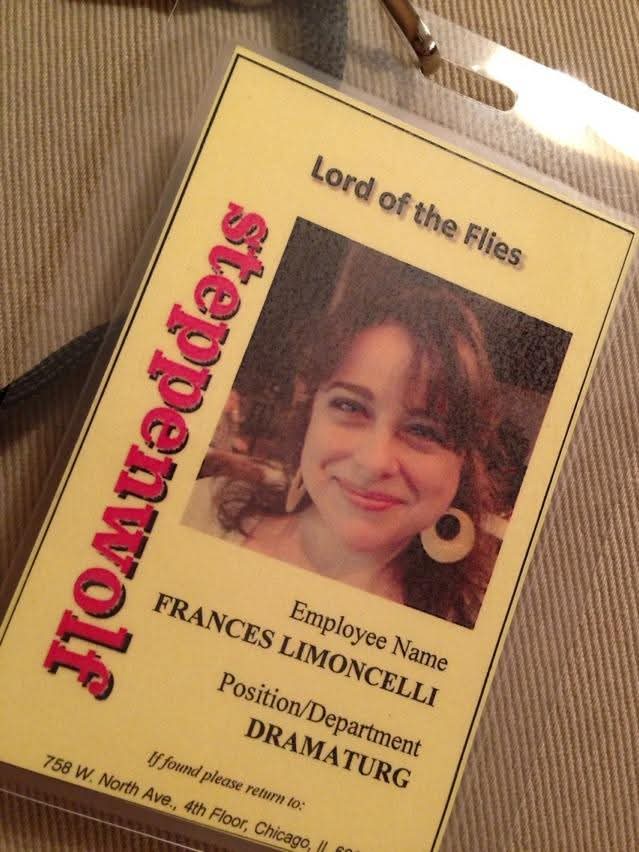
Ms. Limoncelli has taught in schools for over 20 years. Since joining Latin in 2024, she has instructed Advanced Acting Company and Speech electives, as well as the Playwriting and Directing class. She also directs various school plays and musicals, such as the recent showstopping “Anything Goes.”
Before even stepping foot in a classroom, Ms. Limoncelli’s first love was singing. “My family tells me that I sang in my crib before I could talk,” she said.
As she became older, singing became a way of expressing herself, especially when she failed to find the words to do so. “I was painfully shy as a kid,” Ms. Limoncelli said. “I couldn’t even make eye contact with people. I couldn’t speak to somebody who wasn’t in my family or who I didn’t know very well.”
To overcome this shyness, Ms. Limoncelli intentionally dove into theater. In middle school, she started taking many singing and dancing lessons, “even though it felt out of [her] comfort zone,” she said.
Through practice, she developed a strong talent in both of these areas. In her first year of high school, she auditioned for the musical. “Everybody thought I was this quiet little mouse. Then, I got on the stage and sang this huge soprano song and shocked them all, and that felt really good,” she said.
Ms. Limoncelli also pursued her passion for singing outside of her high school, gaining professional experience at a young age. In her senior year, she performed as the singer of a Top 40 band (a band that is able to play the most popular songs of the time period). Her exceptional voice and work ethic allowed her to succeed despite her youth. All the other performers in the band were in their 30s, and she was 17.
“I got permission to have no early classes … because five nights a week, I was singing at Sheraton Inns and Ramada Inns until 2 a.m.,” Ms. Limoncelli said. “If it was a hit in the ‘80s, I probably sang it on stage.”
The performing arts were not her only passion, however; she also loved teaching, and even as a young child, Ms. Limoncelli frequently taught her siblings and other younger kids, explaining things that they didn’t understand.
“I’ve always loved the process of being excited about something, and explaining it to others, and hopefully getting them excited,” Ms. Limoncelli said. “I was the super nanny, super babysitter, superstar. Starting from when I was 12 years old in my town, families would fight over who got me on a Saturday night.”
Ms. Limoncelli took her love of teaching with her to college and onward to her adult life. Before she joined Latin, she would visit schools as a guest speaker, offering drama and performance workshops. Her unique experience across many schools and communities have given her the opportunity to connect with a diverse range of students.
When her colleagues would try to label a “problem kid,” Ms. Limoncelli learned not to get deterred. “That kid was never the problem kid for me, because that was the creative kid,” she said.
One particular class with a so-called “problem kid” left a lasting impression on her.
“There was a kid who didn’t speak very much. I had brought along scarves of different colors. And I gave that kid—who was the ‘problem kid’—this red scarf, and I said, ‘Could you move the scarf in a way that means red to you?’ And this kid took off and poured all his frustration and anger into this movement,” Ms. Limoncelli said. “I could tell it was because he didn’t feel seen in that class. I wanted to cry. It was beautiful. I thought to myself, ‘I could really do this for the rest of my life.’”
Ms. Limoncelli lives for these moments of student learning. “[Teaching] is the most fulfilling thing I do, and it is the hardest thing I do,” she said. “What makes me get up in the morning is feeling needed and purposeful.”
Throughout her vast teaching experience, Ms. Limoncelli has learned to be flexible and to own up to her mistakes. “I do [that] to be honest and authentic,” she said. “I don’t want to pretend I didn’t just mess something up, right? I feel it’s important to model that it’s okay to mess up. We’re human. I don’t expect anybody to be perfect.”
Even without an expectation of perfection, everything Ms. Limoncelli teaches demands vulnerability. “I’m not putting anyone in physical danger, but some emotional risk, putting yourself out there, giving speeches, is vulnerable. Doing creative writing, playwriting, right out of your imagination, and showing that to other people: that’s vulnerable. Getting up and acting out an emotional scene, your character isn’t the only one who’s vulnerable,” she said. “You’re taking an emotional and a creative risk doing that.”
In both Ms. Limoncelli’s Advanced Acting Company class and in the plays that she directs, her students are eager to let her push them take these risks and improve their performances; they trust her.
“[Even though] Ms. Limoncelli is mostly the director, focused on the acting and how [the play] all came together at the end, in the dance meetings, she would sit in while we were doing the De-lovely dance,” junior and “Anything Goes” actor Alex Stamos said. “She would give us notes on how it would be reacted upon on the screen. This [was] truly my first time acting. It was really nice of her, and she guided me through the entire process.”
Ms. Limoncelli’s Speech class provides the same atmosphere, but it attracts students who are newer to performing. “When I am in Ms. Limoncelli’s [Speech] class, I feel that her methods of taking us out of our comfort zone, in terms of public speaking, force us to adapt to being up in front of others,” freshman Ojas Gupta said. “The environment she gives us is pressure enough to make us succeed, but if we don’t feel confident, we always have a kind person to refer to before going again.”
Ms. Limoncelli’s range across these settings shows one of her biggest points of pride: her ability to adapt her teaching to different kinds of students. “Part of the challenge of being a teacher is that there’s no cookie-cutter way [to teach], because every student is a unique individual,” she said. “So I’m always trying to figure out, ‘What does this student need to be successful?’”