

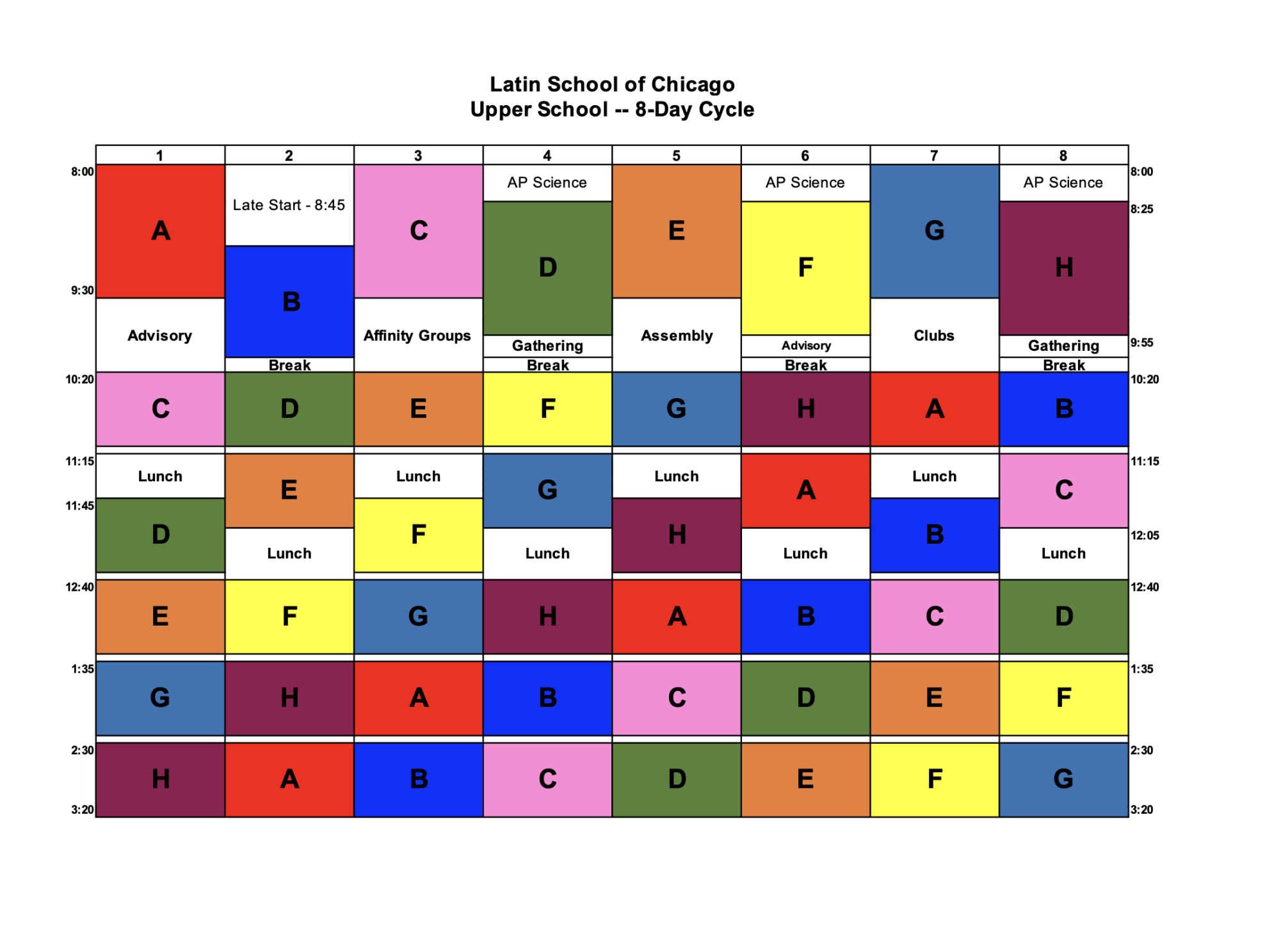
Each morning, students scan their phone calendars for the day’s number: Is it a Day Two or a Day Eight? A single digit determines nearly everything during the school day, from where students begin their morning to how long their lunch lasts to how many free blocks they have.
While most high school students follow a predictable Monday-to-Friday school schedule, students at Latin navigate a completely different calendar, which impacts how they experience school every week. For nearly 40 years, Latin’s rotating eight-day block schedule has set it apart from traditional high schools.
How did Latin end up this way? This model evolved over decades of trial and error, as the school searched for the optimal balance between learning and flexibility in students’ everyday lives.
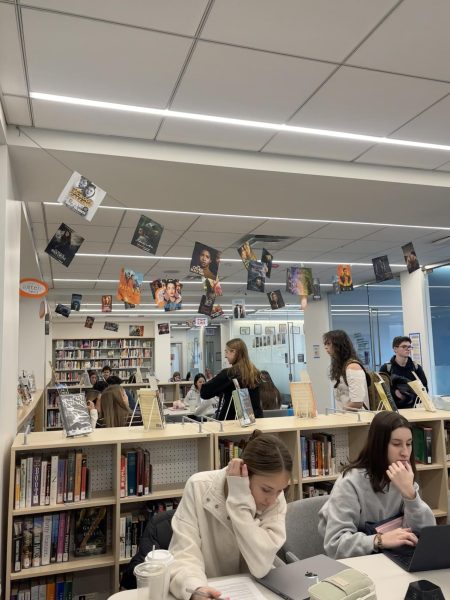 Upper School quiet area during a free period. (Mira Wojno)
Currently, Latin operates on an eight-day, eight-block rotating schedule, with one 90-minute-long block each morning and remaining classes meeting for 50 minutes, separated by five-minute passing periods. Most mornings also include community time after the long block, and only six of the eight blocks meet each day, giving students two off days per cycle in each class.
But while the system can seem convoluted and may take time to adjust to, earlier versions were even more complex.
In 1987, the first rotating schedule was implemented. There was a “super traditional schedule, where every class met at the same time every day,” said Upper School Director and former Latin student Nick Baer. This new schedule consisted of 19 twenty-minute “mods” that were grouped into classes or community time. The school day began at 7:45 a.m. and ended at either 2:46 p.m. or 3:30 p.m., depending on the day, with four minute breaks between classes.
This change was developed to reduce problems with the first and last blocks of a traditional schedule—tiredness affected students’ concentration in the morning, and athletes often had to miss the last class of the day. Director of Academic Initiatives Ingrid Dorer Fitzpatrick said, “One year, when I was teaching Euro History AP, the first time [a student] did not have a conflict because of sports was Oct. 26. An entire quarter had gone by before we met for the first time as an entire class.”
Rotating blocks helped alleviate this issue, so the same classes weren’t affected every day by absences. To accomplish this, classes that took up morning mods—A, B, and C—interchanged. Mods G and H, always at the end of the day, would also switch off. Blocks D, E, and F, in the middle of the day, remained unchanged to avoid causing difficulties for lunch periods and part-time teachers.
This next rotating schedule incorporated feedback from the Science Department, which requested more lab time. The addition of one more mod allowed this shift, and it also enabled other classes to meet more than 10 mods per week.
With this revision, students weren’t given off days for any of their classes. Instead, whether the class received a break was up to the discretion of the individual instructor. Some teachers saw the extra mod as advantageous for courses like language, where more time could be allotted for consistent conversational practice.
In 1991, the Academic Affairs Office revised the schedule once again. Passing time was extended to five minutes, and the school day was lengthened by 25 minutes. Now, however, assemblies took place only at the end of the day, instead of being before the last two periods. This change was supplemented to accommodate student-athletes once again, so they did not have to miss class time.
Many students didn’t appreciate this change. “I used to look forward to assemblies in the middle of the day; they were a time we all could take a break from our regular classes,” Judd Horn ‘92 said in a 1991 Forum article. “Most of us were still awake and had enough energy to pay attention to what the speakers had to say. Now, they’re at the end of the day when we are all worn out from schooling. Hey, well at least I don’t miss my class because of sports.”
In the late 2000s, after hearing of other schools allowing class off days and long blocks, Latin brought in outside consultants to work with faculty, gather feedback, and test ideas. The process involved a long period of trial and error before the current schedule was implemented.
The design of the current schedule reflects years of compromise among academic, social, and logistical priorities. “There have always been differing opinions on long blocks,” Mr. Baer said. “Some departments really like them, while others would prefer to meet more frequently or for shorter periods of time.”
Despite the ongoing debate, the 90-minute-long block has remained a constant feature of the day. “Many classes really benefit and make use of long blocks for labs, assessments, presentations, or projects,” Director of Academic Affairs Ash Hansberry said. “This also means that students with free blocks have sleep-ins or days they end early, which many students like.”
Students also appreciate the variety that the rotation gives them. Freshman Henna Chamlin said, “I like how it’s not the same thing every day, and you don’t get sick of things because there’s a good mixture of what [class] you have during long block and then the time of day when you have that class [later in the week].”
 Upper School cafeteria between lunch periods. (Mira Wojno)
Still, Mr. Baer emphasized that no variation can satisfy every demand equally. “There are so many competing needs; it’s really hard to find a perfect schedule that meets all of them,” he said.
Lunch, for example, still poses a challenge. “It can be a crunch every day for lunch with everyone in the cafeteria,” Mr. Baer said. “There aren’t enough periods for students to always comfortably eat.”
Students have also expressed challenges with navigating the two lunch periods and how to differentiate them on their schedules. “It was confusing, at least when I first started,” Henna said. “I didn’t know how to tell if I had early or late lunch. After two weeks, I knew what I was doing. It’s easy to follow, but challenging since I couldn’t use my phone.”
Currently, the schedule also creates complications for faculty members who work across divisions. Because the Upper School and Middle School schedules do not perfectly align, scheduling becomes difficult, especially for performing arts teachers who teach in both buildings.
While major changes were once again proposed for the 2023-24 school year, none of the changes ended up fitting better.
“One major goal of those proposed changes was to have better alignment between Middle and Upper School schedules, to better facilitate shared space in the building and potential collaborations between divisions for students,” Mx. Hansberry said.
Other changes directors discussed included more time in school for clubs and co-curriculars. Faculty also expressed mixed opinions on the details of community time, including how much time should be spent and during what part of the school day, to allow for more field trips or service opportunities. Most of all, community members perpetually questioned whether to start later in the day.
Although research suggests a benefit from late starts, administrators concluded it’s not a feasible change. “Starting later means ending later, which presents its own challenges, especially when factoring in co-curricular activities or sports,” Mx. Hansberry said. “In fact, starting later, adding community time, lengthening lunch, etc., would all either have to lengthen the school day or take away from classroom time.”
Overall, the Academic Affairs Department found that alternate schedules created more problems than solutions, with few variations they found feasible or exciting.
“No major proposals for changes have been considered since then, and there are no currently in-progress proposals to change the schedule,” Mx. Hansberry said.
For now, the system that started as an experiment nearly four decades ago remains firmly in place.
“I think the block schedule is super cool,” junior Egan Cloudman said. “It lets me really focus on things that I enjoy while also giving me times to work on other things during the day.”



Anne Hartley • Jun 12, 2026 at 4:09 pm
I love the behind-the-scenes articles about the school! (I also loved the facilities article.) Keep them coming.