
















Iran closed the Strait of Hormuz on April 18 in response to a U.S. blockade, disrupting global oil shipping through the strategic pathway and marking a major escalation in the U.S. and Israel’s military campaign against Iran. The war has shaped student discussions at Latin and resonated personally with students and teachers alike.
The war began on Feb. 28 after years of regional tensions, including the Middle Eastern crisis in 2023 and missile exchanges between Israel and Iran in 2024. Since then, both sides have exchanged retaliatory strikes, including U.S. attacks on Iranian nuclear facilities. Tensions escalated when the U.S. killed Iran’s Supreme Leader, Ali Khamenei, early in the conflict.
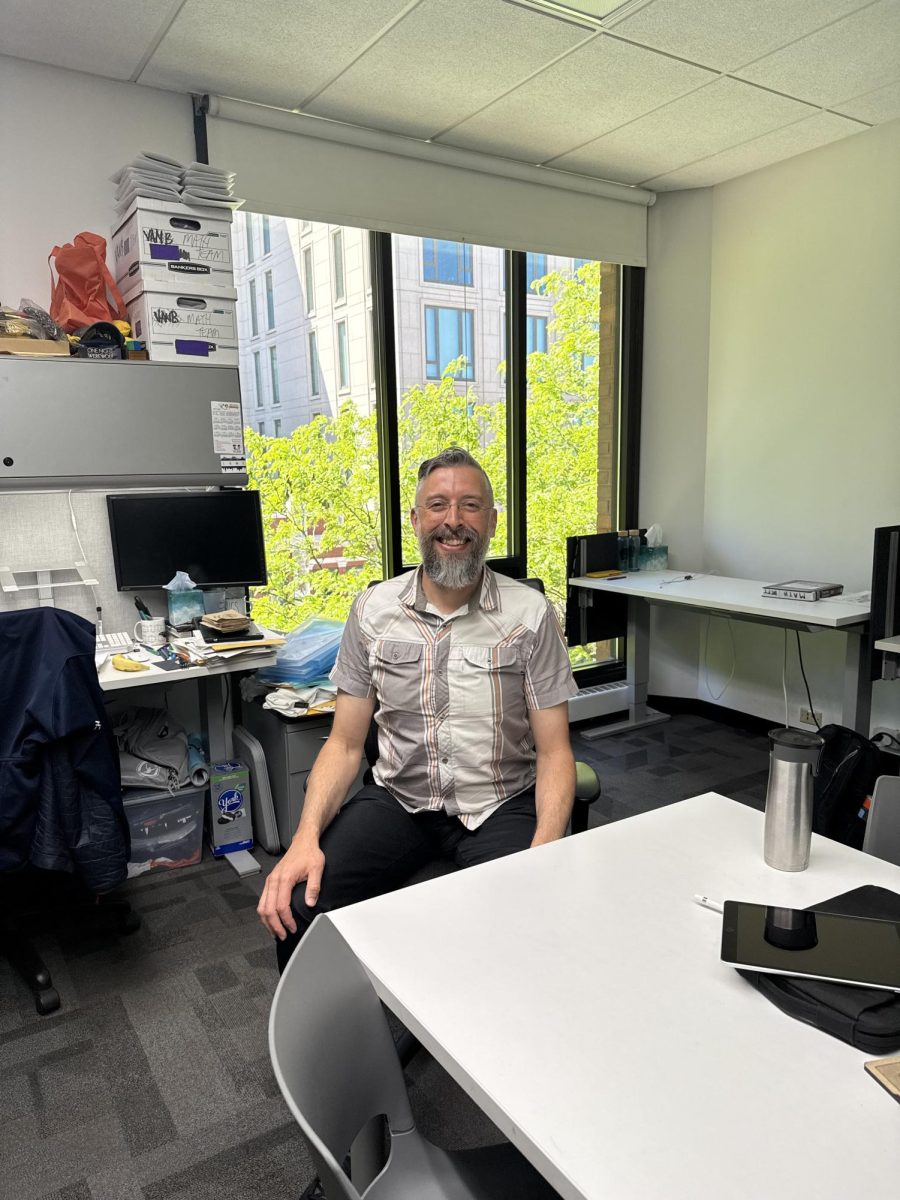
To understand how the conflict reached this point, Upper School history teacher Jeremy Goodman, who teaches the sophomore history elective Middle East, pointed to a long history of involvement. “America has been involved in the region for many years and has played a role in Iranian domestic politics,” Mr. Goodman said. “[It] has had a tense and challenging relationship with Iran for more than 40 years.”
He highlighted the 1979 Iranian Revolution as a key turning point. “Part of [the revolution] was being against American involvement in the region,” Mr. Goodman said. “A lot of that hatred and resentment is built up on Western involvement, and the thought is that America was inserting American-aligned leaders into Iran to help our own interests and not the Iranian people.”
Even with that long-standing friction, the scale of the current conflict is striking. “I was not surprised that [military] action had been taken considering the military build-up in the region, but I was surprised at the size and scope of the operation,” Mr. Goodman said.
U.S. leaders, including President Donald Trump, have justified the war by arguing that Iran poses a major threat and must be prevented from developing nuclear weapons. Officials have also suggested that the goal of the war is to weaken or overthrow Iran’s government.
Mr. Goodman explained that those concerns about Iran’s nuclear program are rooted in long-standing fears of nuclear weapons development. “From the larger American perspective, Iran has been attempting to [develop] nuclear weapons at least in the last decade,” he said. “America sees that it is not in our interest to allow Iran to have nuclear weapons.”
Even so, many question the purpose of the war. “I’m unsure why we really are there,” Upper School history teacher Debbie Linder said. “I don’t know what our objectives are. I’m not quite sure what [the war] is for.”
The ambiguity over the motives of the war has had broader consequences on the economy. “That lack of clarity is very confusing, very disruptive; if you look at the markets, they're all over the place,” Ms. Linder said. “They usually react on little things or big things. And this is a pretty big thing, especially with the supply of oil.”
The consequences of the war in Iran have extended globally, with instability in the Middle East driving volatility in energy markets. Concerns over the security of the Strait of Hormuz, a key route for global oil shipments, have further increased uncertainty. The war has carried high financial costs; the first 100 hours alone cost an estimated $3.7 billion.
This military operation has already had a significant human cost as well. According to the international news agency Reuters, the war has taken the lives of over 3,000 Iranians—including civilians—and many more Middle Eastern citizens from other countries.
“I don't know how to feel anymore, because every day is a new shocker, and I don't want to ever become numb to it, because that's dangerous,” Ms. Linder said. “I think we need to be reminded of all the people that are being affected by this and the ripple effect [the conflict is] going to have in the world.”
Quoting Edwin Starr’s “War,” she added, “What is [war] good for? Absolutely nothing.”
However, some students view the war from a more personal standpoint, including sophomore Laily Uribe, whose family emigrated from Iran in the 1980s. “I am honestly happy that there is a war going on,” Laily said. “The Iranian people have been suppressed by the Islamic regime for many years, and now this is finally a break in the revolution. As bad as war is, it’s another step [toward] getting rid of the Islamic regime and having a better Iran.”
Laily’s family history illustrates the dangers that pushed many Iranians to leave. “It was just not safe for my family to live in Iran anymore,” they said. “They knew that it wasn’t going to be safe for their daughters to grow up there.”
Their family faced direct danger because of their grandfather’s involvement with U.S. intelligence. “My grandfather got drafted by the American CIA during the Islamic Revolution, where he would often raid houses to bust fugitives in Iran,” junior Tanier Uribe, Laily’s brother, said. “The Islamic Republic, in retaliation against the CIA, first started by chopping my grandfather’s friend into pieces on the street, and broke in to take my grandfather hostage but later releas[ed] him.”
After the revolution, his family directly experienced restrictions on freedom of speech, press, religion, and more. “Since the Islamic takeover, Shia Islam was forced on the public, women had to cover their whole bodies, LGBTQ+ were executed, and they silenced anyone who spoke against the regime,” Tanier said. “My uncle made anti-regime songs, and they messaged him to stop talking about Iran or they [would] kill him. He stopped speaking completely, but still makes songs to this day.”
Those restrictions were especially strict for women. For example, women were not allowed to play sports, yet Laily’s aunt dressed as a boy so she could play soccer with boys. “It was a big risk, because if someone caught my aunt doing that, she could possibly die just for wanting to play sports,” Laily said.
For their family, leaving Iran was ultimately about survival and freedom. “They moved for the better of the family and for more chances at life,” Laily said. “Otherwise, they probably could have been executed, like thousands of other people have been.”
Even today, their family remains in danger. “My mother’s house in Iran was blown up by the regime, and my family is actively fighting against the regime,” Tanier said. “One of my relatives said she would rather die protesting than die under the regime.”
One of Trump’s stated goals for the war is to weaken or overthrow the Iranian government, a stance that has shaped how Tanier and Laily view the conflict. When the news of America’s military operation against Iran broke out, Laily and Tanier’s entire family was thrilled.
“My mom, for the longest time, has been talking about how her country is being suppressed because of the Islamic regime. So I was very happy and overwhelmed,” Laily said. “I didn’t expect something like this to happen now, because it’s been such a long, continuous thing with the Islamic regime constantly suppressing people, suppressing women specifically.”
Tanier shared a similar reaction within their family. “We are so happy this is happening, and every day is a celebration,” he said. “When Ali Khamenei died, my mother cried of joy, and my sister was shocked. This finally means an end to prosecution [of] women, and freedom for all.”
Still, Laily noted the process may take time. “I'm not expecting a switch to flip, and then we're gonna just get a completely new regime,” Laily said. “But I think what the war is doing is really good, because it's a step. It's initiating something.”
Tanier added, “People should know that Iran isn’t being governed by good people; they are terrorists.”
At the same time, reactions are not uniform. “My classmates [at] Latin are very uneducated about the war and are against it; therefore a lot of my classmates find me to be crazy,” Tanier said. “I think the problem is that people haven’t actually talked to an Iranian before. I've converted my friends to support the war after I talked with them about it.”
Such contrasting perspectives have also carried into classroom discussions at Latin. “In my Middle East class, we are talking about this frequently, and I do current events in my long block ninth-grade classes,” Mr. Goodman said. “So far, we have had many productive conversations that have been meaningful for students.”
Amid shifting objectives and global consequences, the outcome of the war remains uncertain.
“Everyone can map out and make predictions about what's going to happen when a war starts, but the bottom line is [that] once people start fighting, everything is unpredictable,” Mr. Goodman said. “If anyone said, ‘America [would] have troops potentially going on the ground to fight in Iran’ six months ago, people would have said ‘no way,’ and now it's looking like a real possibility.”
But for some students, the focus is less on predicting outcomes and more on finding ways to respond. Laily has been using social media to raise awareness about the conflict and to support Iranian civilians. Online, however, reactions to the war have been mixed, with some posts expressing support for military actions while others criticize the violence or share images of its human toll.
“As a teenager, you don’t really have a lot of power besides your voice, and so I want to be able to use that to its full capacity,” Laily said. “Being so far away from Iran, I obviously can’t do anything physically, but I can use my voice.”

Deborah Linder • May 9, 2026 at 9:11 pm
Nice article, Edie. Great job finding different perspectives!