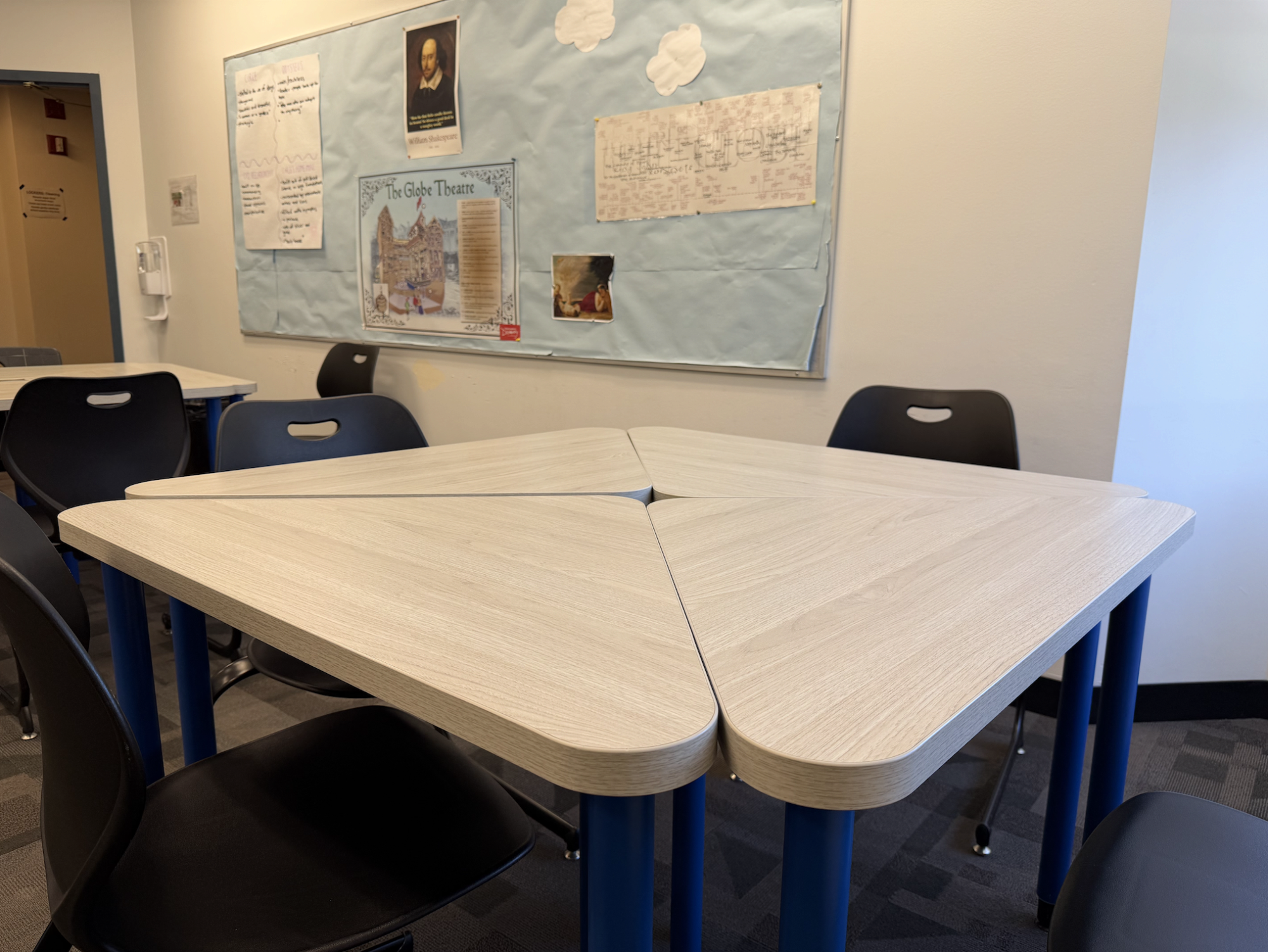
No one at Latin likes the Dorito desks. They’re misshapen, hard to move, and fall over constantly. But since 2022, they’ve been a staple for Upper School students.
Parents sit at them for conferences, perplexed as to how their children manage to stay behind them every day. Prospective students anxiously scoot into them during shadow days, unsure of where to put their backpacks or how to acclimate during class. Upper Schoolers slump into them during long blocks, wearily watching the clock for their break. Every 50 minutes, these desks hold someone new.
The Dorito desks collect memories through quiet repetition. While they may seem insignificant and a frustrating shared experience among my peers, each imperfection represents a different person who came before us.
Every B block, I file into the same desk in Room 230. It’s on the right-hand side of the room, my back to the board. By now, it has become a robotic part of my routine; I walk in, say “hello” to Upper School history teacher Grzegorz Gaczol, and pull out my computer. Sometimes, during class, I catch myself trying to decipher the faint drawings inscribed on the desk's surface. Most of them are just carelessly scribbled blobs of graphite that blemish the dull, grey-white vinyl. Occasionally, a clean line catches my eye. A drawing, maybe a message, worth investigating.
Most days, I am focused on topics like the Vietnam War and how to prepare for my upcoming Socratic seminar.
Occasionally, though, the thought crosses my mind that one day, I will get up from that desk and never sit down at it again.
I will get my course assignments for next year and wander past the same US230 room, recalling the fading memories of the “where is that on the Unit Plan?” conversations I had with my tablemates. Or the amount of times I had to lug it across the room for an assessment, or the hours I had to spend navigating JSTOR and the Latin LibGuides, a complaint slipping from my mouth every five minutes, grasping the edge of the Dorito-shaped desk:
“I’m so tired. How much longer do we have left?”
“How is this document 21 pages long?”
Although I will still walk by, I may never return to that desk again.
It will feel like any other day: The lesson will have ended, I will pack a plethora of pencils into my bag, and I will walk up the northeast staircase to embark on the rest of my school day.
And then someone else will sit there.
“My” desk will not remember me. It will have the same chip on the upper left curve and the ominous, shapeless mass of dark coloring, but the next student to inhabit it may not notice any of those details. They will have their own routine, their own memories, and their own experiences at that desk.
It is easy to think of the school year as a chain of big events: Homecoming, Halloween, Winter Formal, and Prom, just to name a few. But each day that you are in the building, there are hundreds of fragments of events that are made from your own repeated behaviors. It’s these mini-moments that make up days, months, years, and—ultimately—life: sitting in the same place, at the same time, with the same people, doing seemingly mundane tasks that amount to something bigger.
After the first month or two of school, no one spills awkwardly into their seats. The clock turns 10:20 a.m., students huddle with their habitually designated groups, and a peer always forgets to do the reading. I slide into my white-and-gray triangular desk and find the same chipped surface I’ve felt for the past two months.
By May, the motions blend like a dance. No one notices them happening, yet each person participates, a quiet ensemble.
Until the desks are rearranged in a six-person circle for finals, and suddenly the routine is interrupted.
The Dorito desks are a constant in each and every one of our lives, playing an unnoticed role that feels insignificant until they are gone.
By the time the bright fluorescent lights flicker on again in August, the desk will still be there, but someone else will be anxiously fiddling with the paint. Without anyone noticing, the desk will start collecting someone else’s life in place of mine.