









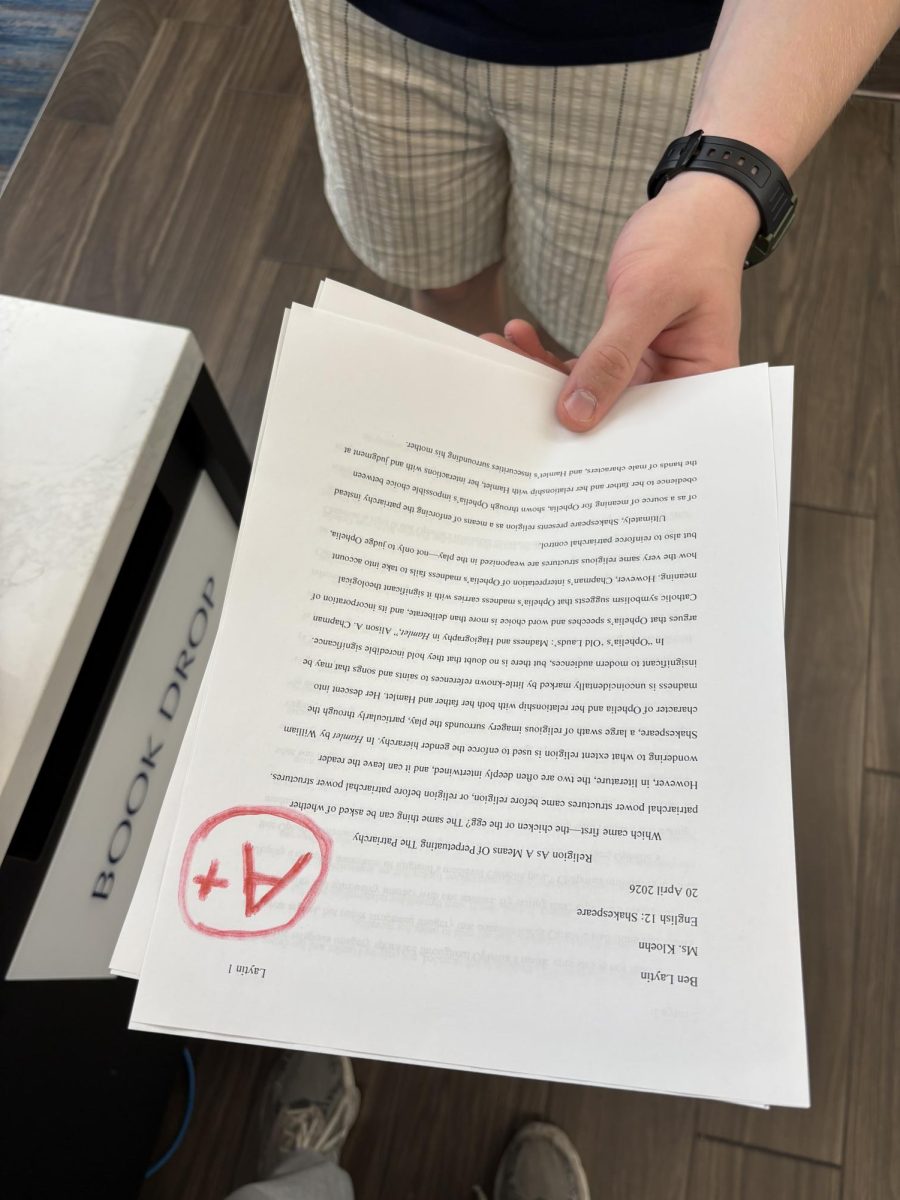

































Fostering deeper thinking is key in English classes. Writing my first Earned Honors paragraph was a challenging experience, but one that came with a lot of growth— a huge benefit of the new English system. While the system promotes meaningful growth, the problem lies in the barrier it creates: Many juniors don’t choose to attempt Earned Honors and receive the benefits because of the harsh grading system, which requires mastery from very early on.
This school year, Latin’s English Department introduced an Earned Honors option into the 11th-grade English curriculum. To earn an honors credit, students must, for each major assignment, write an 800-word essay linking their ideas to an outside source; the goal is to push juniors to make intertextual connections, seeing how the works they study fit into a broader literary framework.
However, if a junior receives a single “partially meets expectations” or more than two “mostly meets expectations” on Earned Honors attempts, they are disqualified from honors credit. Synthesis is not taught in English classes before junior year, and students get very little feedback on their work, even when they get “fully meets” on their pieces. Out of the six Earned Honors assignments throughout the year, juniors only get to revise their work after receiving feedback on their first attempt, and from then are left to their own writerly devices.
Earned Honors has clear strengths: The program rewards sustained academic effort, pushes students to a new level of analytical depth, and encourages students to synthesize ideas across texts, a necessary skill in college.
For those who are able to remain in contention, Earned Honors’ exclusivity can provide a meaningful way for students to distinguish themselves as humanities learners, while building skills they will use in English classes throughout their entire academic journey.
Junior Landry Silvers has so far enjoyed the opportunity for synthesis because of the challenge and the growth that has come with it.
“The Earned Honors program has challenged me to think deeply and develop my voice,” Landry said. “I also use the Writing Center to revise and grow so that every piece becomes stronger and more meaningful.”
In addition to demanding high-level synthesis, the program also catalyzes personal reading choices that students may otherwise overlook, as juniors must read an extra outside source to write their essay.
In my junior year English class, American Families, I decided to attempt Earned Honors to push myself in the subject. I am nearing the end of “The Underground Railroad” by Colson Whitehead, a book I have thoroughly enjoyed reading. However, had I not needed a source for my upcoming Earned Honors opportunity, I would have never picked it up.
While the Earned Honors system has many important strengths for learning, including being the sole reason I chose to read a new book, its exclusivity means many juniors aren’t benefiting from it.
Exclusivity is one of the current Earned Honors system’s largest problems: Many students are either barred from additional attempts by a single bad grade or never make an attempt for fear it would be a waste of their limited time. Many students don’t have the wiggle room they need to adjust to the completely new standard that is being assessed.
Junior Noor Bazzi decided not to go for Earned Honors this year. “I was very intimidated by how easily I could be out of it,” Noor said. “If I messed it up badly once, I’d be out, and it didn’t seem worth the effort if it's so easy to lose.”
Noor’s thinking resonates with me, as it does with plenty of juniors. Why would someone put in all of this work when it feels like the system is working against them?
One of my favorite things about the grading systems for history and English at Latin is how they emphasize improvement. The Earned Honors system, however, is the exact opposite.
I don’t think the Earned Honors system is bad. In fact, I think it's an overall great way for strong English students to differentiate themselves. But as teenagers choose to read less and less for pleasure, the exclusivity of Earned Honors is keeping more students from reading outside of the classroom.
To truly foster deeper thinking, the Earned Honors system should transition to an improvement-focused model in which more of the assignments are returned for feedback, so students can actually learn synthesis. The current structure demands mastery at the beginning, which is at odds with the learning process, especially because neither the English Department nor the History Department teaches synthesis before junior year.
By shifting to a focus on growth over time, the English Department would reward students who struggle initially with synthesis but eventually achieve the higher-level analysis the program encourages. Shifting to an improvement-based approach would also make Earned Honors feel more achievable to students, and more juniors would be able to reap the benefits the system provides.
In the end, it's not a question of whether Earned Honors is effective, as it promotes more reading and learning to synthesize. So far in my experience, even though I don’t know if I will achieve the Earned Honors credit at the end of the year, I am glad I am trying it because of the challenges and opportunities. The question is whether it is accessible enough for students to actually benefit from it. For Earned Honors to inspire deeper thinking, its structure needs to invite students in, not shut them out.