



























Students line the microscopes as they carefully examine fly specimens, occasionally chiming in to the ongoing chatter that engulfs the classroom. In this small, fly-speckled lab room, “girl talk” ranges from DNA synthesis to evolutionary parsimony to, yes, sometimes just good old “girl talk.”
Meet the “fladies”—the students part of a senior biology class that happens to be composed completely of girls.
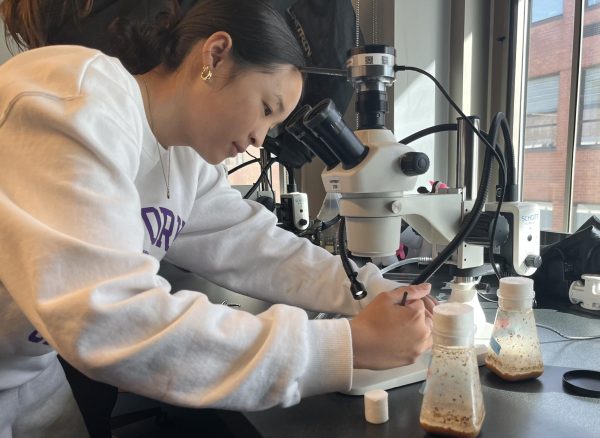
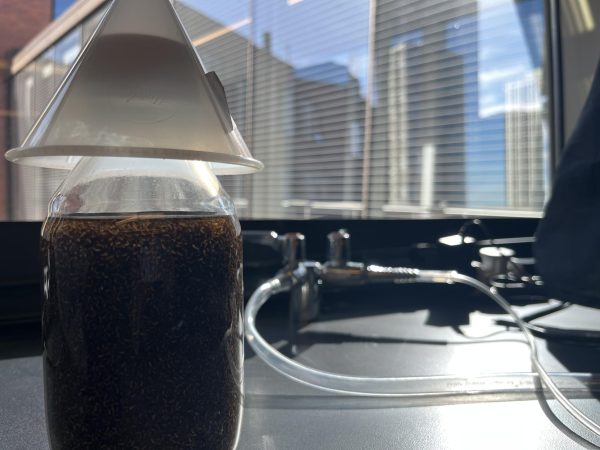
This class, Honors Research in Molecular Genetics, often just called “Flies” by students, began as an ISP during the pandemic. During its initial stages, Upper School science teacher Geraldine Schmadeke kept an incubator in her basement to hold the fly specimens. After a growth in class size over the following years, Flies morphed into a year-long class, eventually splitting into two sections, with Upper School science teacher Melissa Dowling joining to teach the second block.
Since its creation, the class has been more popular among female students, but this entirely female class has become an ideal petri-dish for what STEM classrooms could look like for girls, sans barriers or bias.
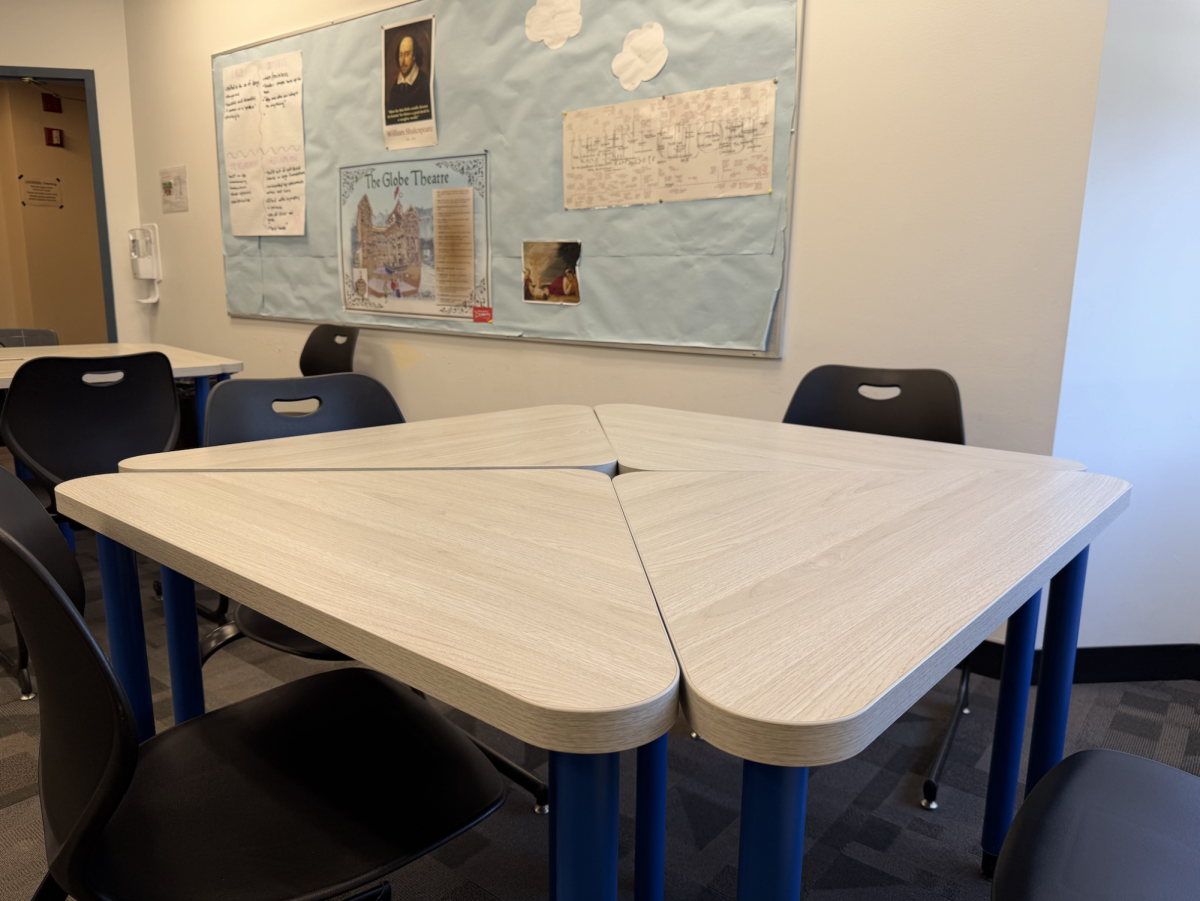
Students in Ms. Dowling’s section have noticed a significant difference in the environment compared with other mixed-gender classes, noting heightened connection between and comfort among peers.
“[The class is] very collaborative,” senior Morgan Sirek said. “No one’s dominating the conversation most of the time. Everyone’s adding things, which I think is better than having a leader and [then] people who are just going along with it.”
Almost as female-dominated as Ms. Dowling’s, Ms. Schmadeke’s section includes eight girls and two boys. The gender differences in these sections introduce questions about female participation in biological sciences compared to other advanced STEM classes like physics.
Senior Sahana Aggarwal, a member of Ms. Schmadeke’s section of Flies, is also taking Honors Multivariable Calculus and AP Physics C: E&M. Sahana said, “In my math and physics, it’s pretty male dominated. There’s just very few girls.”
She said, “I’m less eager to participate in those classes because [they are] so male-dominated. It’s a lot easier to participate in Flies.” At Latin, the girl-to-boy student ratio in AP Physics classes is 4.25 to 10.25 – nearly 1:2.
The less inclusive environment that Sahana finds in her physics and math classes is corroborated by other women in similar fields, such as Ms. Dowling’s experience being one of two girls in a calculus class in college. Her time in the class, as well as teaching science, led her to theorize why girls gravitate toward some scientific disciplines but shy away from others.
“I think it’s this idea that oftentimes physics is seen as kind of math-based and—not that girls don’t like math and do math—but I think traditionally, girls have been more supported in the biological sciences rather than in science that involves math,” Ms. Dowling said. “If you look at stats, it sort of shows that physics is usually more male-dominated. Chemistry is usually 50-50, and then [biology] is usually female-dominated.”
Morgan points to career choices and future planning as driving factors for women in biology. “The most female-dominated major is nursing. And so for people who want to go to med school, they want to be proactive and take advanced-level biology classes in high school so that they’re more ready for college classes,” she said.
Ms. Dowling believes that the increased number of girls in biology can also be a sort of self-fulfilling prophecy, with greater visibility leading to greater participation.
“I think girls probably feel more supported in biological sciences because [there are] just more women in those sciences. And so you’ve got more people to look at and say, ‘Oh, I can be like this person,’” Ms. Dowling said. “Whereas, oftentimes, girls just don’t feel necessarily as supported in physics.”
Traditional gender roles and stereotypes may also amplify girls’ discouragement from math and physics.
“If the gender norm of a girl is to be gentle and patient and think about things before you do them, it would lend to more qualitative things; talking and writing in humanities versus being competitive and emotionless, lending it to quantitative things like math,” Morgan said.
Despite the challenges posed by these ingrained biases, girls’ involvement in classes like Flies can also indicate progress in the growth of women in science, even if a disparity within fields still exists.
“There’s more girls interested in pursuing challenging, difficult, and academic topics,” Morgan said. “I think it’s probably a combination of many factors for why girls may be choosing [biology] and [chemistry] over physics.”
This importance of female community and solidarity in the sciences is powerfully embraced by the all-female environment in Flies. Conversation in Ms. Dowling’s Flies sometimes steers toward the idea of other all-girl environments—notably, for the college-considering seniors in the class, women’s colleges.
“I think especially if you are, if you’re going into the sciences, [women’s colleges] might actually be a more inclusive place for you, because you feel like you can kind of speak up and be involved in classes, and it’s not quite so intimidating,” Ms. Dowling said.
Morgan agreed with this sentiment and connected it to a broader lens of the importance of girls’ participation in science in general.
“I think now that we’ve begun to reinforce it at such a young age, that hopefully there will be more girls in higher ed,” Morgan said.