


















In her office, photos of smiling students line the walls, each on an exchange somewhere around the globe. Yearbooks spanning 40 years fill her bookshelves, opening small portals into the past. An original photo of Jesse Owens at the 1936 Summer Olympics hangs proudly, gifted to her by a former student. A wicker basket filled with fresh pastries rests on her desk, offered from the open hand and heart of Upper School history teacher and Director of Academic Initiatives Ingrid Dorer Fitzpatrick.
A near-mythical figure after almost 50 years at Latin, Ms. Dorer has taught a total of 288 classes throughout her tenure, including Advanced Topics in Psychology, AP European History, Western Civilization, and International Human Rights Law. Dearest to her is a class of her own design: Nazi Mind, a Nuremberg Trials simulation class inspired by elements of her own life.
“My grandfather on my mother’s side spent the first six years, from when the Nazis took over, in Dachau as a political prisoner,” Ms. Dorer said. “He was a social Democrat leader, and he was one of the first people that was put in the camp.” On the other side of her family, she had Jewish relatives, who luckily escaped Germany in 1936.
Ms. Dorer’s family’s connections to World War II complicated life in their small German town, where she was born. So in 1957, her parents decided the family would emigrate to Toronto—and an 8-year-old Ms. Dorer was incredibly reluctant, even celebrating the possibility of illness preventing their immigration.
“I was not enamored to go at all,” she said. “In fact, when [my father] took his medical exams in order to be able to come, when he got his test back, it showed a spot on his lungs, so they thought it might be tuberculosis. I literally still remember clapping. My parents had taken a shock, because it had totally skipped my brain that this could be serious. But I still remember bursting into absolute hilarity and joy.”
The family discovered the spots were benign, and thus boarded the Arosa Star and set sail for Canada. The new country amazed Ms. Dorer. “All of it was shock and awe,” she said.
Ms. Dorer and her family settled in Toronto, and she attempted to adjust to her new reality. “I think the difficult part was adjusting to being away from my family, because we had lived in a familiar multi-generational home,” she said. “I couldn’t speak the language, which was not exactly helpful. The people that lived around me were all immigrants. And so there, I heard a lot of different languages, but not one of them was English.”
By the end of her first year in Canada, she had picked up English. “That’s what happens when you can’t speak to anyone. It’s either do or die,” Ms. Dorer said. “I had no choice. It was either learn English or become mute. I’m not good at mute.”
A few years after immigrating, Ms. Dorer and her family learned that members from their hometown had settled in Chicago—52, to be exact. “In the summer of ‘61, we came to visit them in Chicago. And they, of course, persuaded my dad that he should come to Chicago, where everybody else was, right?”
Ms. Dorer began her life in Chicago at Immaculata High School, not far from Latin, with plenty of immigrant students in her class. “High school, it was kind of a new start for everybody,” she said. “And in terms of immigrant families or non-immigrant families, you weren’t really the one kid who came from some weird place that nobody else came from. A lot of people did.”
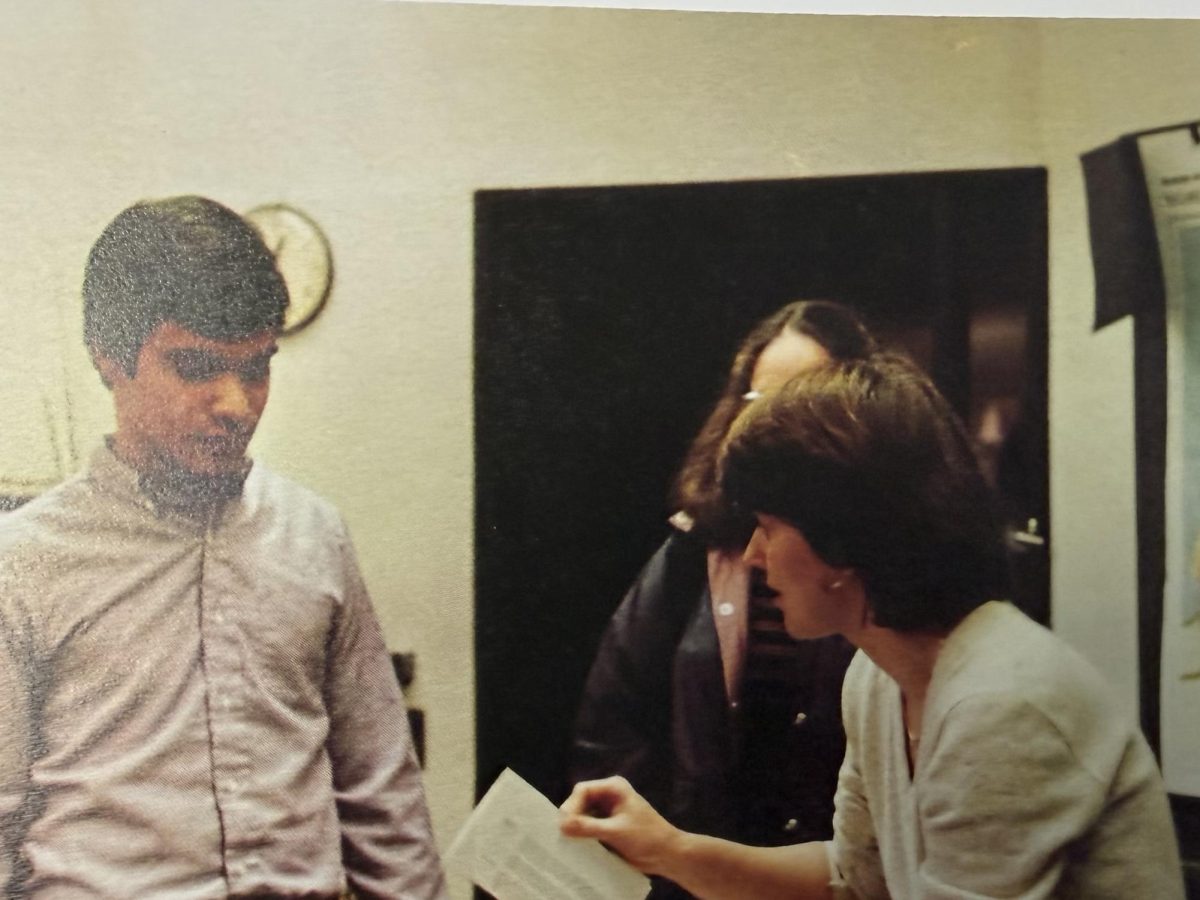
 Ingrid Dorer flips through papers in her classroom in the 1981-82 school year. (Latin Yearbook 1982)
Ms. Dorer’s high school experience during the Civil Rights Movement of the 1960s shaped who she became as an adult and teacher. “The nuns who happened to run my high school, although the setting itself was traditional, they were not. They were social activists,” she said. “All of the civil rights stuff was a backdrop to this [learning].”
Through her school, Ms. Dorer became heavily involved in the voter registration movement, helping people across Chicago exercise their civil rights. “A lot of voter registration was happening, and that was really significant because there were tons and tons of people who could not vote,” she said. “So we became part of a larger movement to try to do that in particular.”
These formative experiences with social justice shaped her perspective. “I really do wonder what would have happened had my touchpoints been different than they were,” Ms. Dorer said. “Had I been born at a different time, had I come here at a different time, had I gone to school at a different time in a different setting—I don’t know that I would have noticed those things. At least not then, and not having it be integral to the rest of my life.”
Ms. Dorer’s classes recreate these formative circumstances for her current students. “I think what I walked away with is not one lens through which to look, but the skill is to look at different lenses at all times,” she said. “Part of it is exposure in a classroom, exposure intellectually, but then also trying to make it real by having people exposed to differences universally, globally. I think that’s really important—and that carries way beyond whatever subject you’re doing.”
To combat the injustices of the present, Ms. Dorer turned to the past, studying medieval literature at Loyola and exploring the biases and prejudices that arose within the texts. “So a lot of what I do today is sort of an offshoot of that same kind of thing,” she said. “What gets you in that situation where people interact successfully and can figure out how to navigate differences?”
Her journey to teaching at Latin was, as she described, “a comedy of errors.” When she was originally offered a job at the school in December 1978, Ms. Dorer hadn’t even heard of Latin. But a history teacher had decided to resign from her position mid-year, and Latin needed someone to finish the semester. “So, what happened is the history chair called around to all the graduate schools in the area, asking about if they had any graduate students. And [they were] literally saying, would anybody want to do this for three months?” Ms. Dorer said.
Her dissertation fueled her decision to accept the job. “Unlike most of my colleagues who came here, fully intentionally, kind of applying to Latin School of Chicago, I did not,” she said. “I was looking for something that would supplement my fellowship. And what was attractive was the idea that this job would only be for a few months.”
Little did she know those three months would turn into a lifetime, as she’s now midway through her 48th year.
Ms. Dorer’s relationship with students propelled her to teach her whole life. “It’s kind of a silly long shot as to why I’m here. It’s not a long shot as to why I stayed,” she said. “There’s an energy that comes from a classroom and the interaction with students that I was fascinated by.”
Classroom dynamics intrigued Ms. Dorer from her very first class at Latin. “It was a Western [Civics] class, 18 students in the class. I remember this class was like the biggest challenge in the world, even the first day. But they were with me, and you can tell when people are with you,” she said. “The very first class, I remember going, ‘Okay, I’m going to have to shift gears every 10 minutes.’ But when I did, I didn’t lose them. It was the kind of challenge I love.”
“What that taught me was, you know, read kids, but also talk to them,” she said. “No, they don’t always necessarily know what exactly it is they want. But they can tell you enough, so that you can shape something that works.”
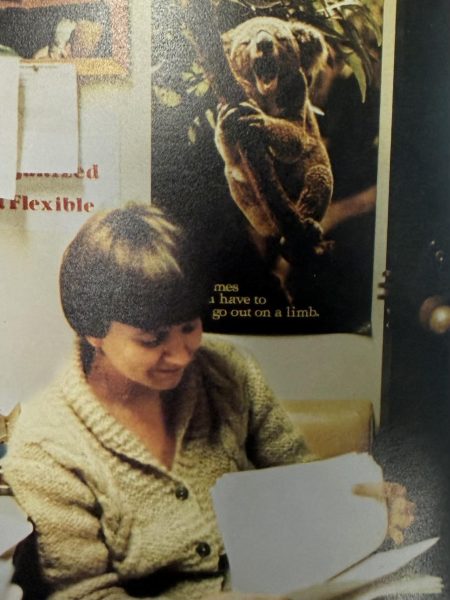
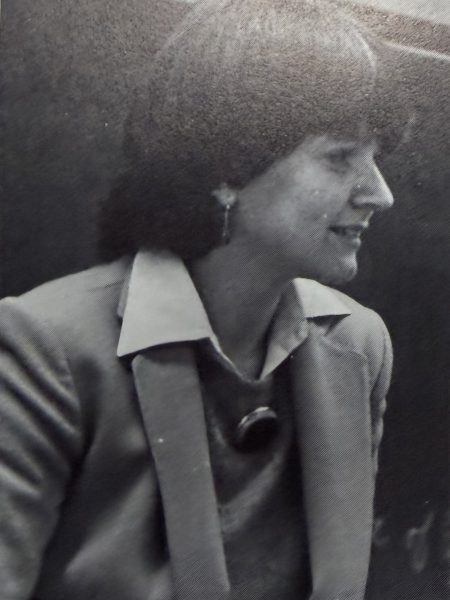 Ms. Dorer’s profile picture for the 1982 yearbook (Latin Yearbook 1982)
Ms. Dorer’s past students, including Latin alum Kelly Seeman ‘95, remember her teaching style that emphasized hands-on learning. “She just was a really unique, incredible teacher, very inspiring, and wasn’t about giving us the answers, but all about how could we find the answers to the questions? How could we look for the right information?” Ms. Seeman said. “She made her teaching style very active for the students.”
Students’ vibrant passions, like Ms. Seeman’s, inspired Ms. Dorer’s iconic class: Nazi Mind. It was students who said, ‘We’re really interested in the history of racism and antisemitism and all this stuff.’ I was fueled by students’ energy around the idea of this class.”
Nearly a half century later, students still engage with Ms. Dorer’s creation. This year’s Nazi Mind class culminated on Dec. 7, 2025, with its simulation of the Nuremberg Trials. “After almost 50 years, what’s interesting to me is that the topics still resonate, right?” she said. “They’re not something that somehow was over in 1945, and I’m still trying to teach 1945.”
A current Nazi Mind teacher, Upper School history teacher Jeremy Goodman, described his experience co-teaching the class for the first time this year and stepping into Ms. Dorer’s legacy. “She’s an incredible well of wisdom. Her knowledge on Nuremberg and the trials is overwhelming,” he said. “I think she’s never missed a trial, so that’s 45-plus years of never having something come up, and being able to be there for everyone. So it’s pretty cool to actually see it for the first time this year, and experience her legacy.”
Ms. Seeman felt Ms. Dorer’s impact on Nazi Mind shaped her as a student. “It was probably one of the most unique classes I took in my entire life—like, all of high school, all of college—and I think a lot of my friends feel similar,” she said. “I don’t think I’ve ever had a class like this that was so experiential and really kind of brought you in, and made you live and think and have feelings about the history, versus just learning and being tested on it.”
Upper School Director Nick Baer ‘96 also experienced Nazi Mind. “As someone who took Nazi Mind as a sophomore in the mid-90s, I can tell you that it had a huge effect on me as a student,” he said. “It was just a really phenomenal experience. So it’s really cool when I get to go to the trial these days and see students having that same responsibility, and that same feeling of taking ownership over your learning and then presenting it in such a dynamic way.”
Ms. Dorer’s interest in experiential learning and global perspectives expands beyond the classroom and into the exchange programs. “When I first became involved in exchanges, I realized how much opportunity there was for people to learn and to grow from the interaction,” she said.
She felt that an exchange, like a class, is an opportunity for connection and collaboration. “You sense very quickly the commonalities [between people], but you also see things that are different in our experiences,” Ms. Dorer said.
Ms. Dorer can recall many connections she witnessed because of exchange programs—one of them being Ellie Falk, who participated in an exchange in Cape Town her freshman year. “[My exchange’s] name is Anna Solomon; we clicked instantly, and we became best friends,” Ellie said. “By the end of our exchange, I was really hoping I could stay longer. And then she came in December of that year. She stayed for about a week and a half with her school, and then we wanted to spend extra time with each other, so then she ended up coming back. And we’re best friends to this day. I love her so much.”
Ms. Dorer adores stories of connection, just like Ellie’s. “I absolutely became a believer that [exchanges are] one of the things that can be, and has been for many, many people, life-changing,” she said. “And I love seeing that happen.”
Through curating classes and building relationships, Ms. Dorer has touched the hearts of generations of students and prepared them for adulthood. Ms. Seeman said, “In work, everything is so much more experiential, versus philosophical. And so I think the best way to learn is by doing, and I think [Ms. Dorer] was giving us the gift of learning how to be independent.”
Mr. Baer also emphasizes Ms. Dorer’s incredible impact throughout Latin. “Every school has a teacher or two that has been such a mainstay at the institution that they become synonymous with the school itself,” he said. “And when you have someone who’s as innovative as that for so long, it really leaves a mark on a school, and changes how other people teach and how other people are inspired to innovate in their classrooms.”

Stephanie Stephens • Jan 29, 2026 at 8:44 pm
A wonderful tribute to the pillar of the Latin community. I’ve known Ingrid for 27 years. Her innovative, interdisciplinary approach to teaching—including 9th-grade Humanities and American/European Civilization—drew me to the Latin School of Chicago. Her student-centered approach to both teaching and school governance kept me inspired. She’s an artist and an intellectual who will drop everything for a coffee and a conversation. She’s simply the best.
Tolu • Jan 29, 2026 at 8:11 pm
I really enjoyed reading this. What a beautiful writeup about the incredible IDF. We love her.