











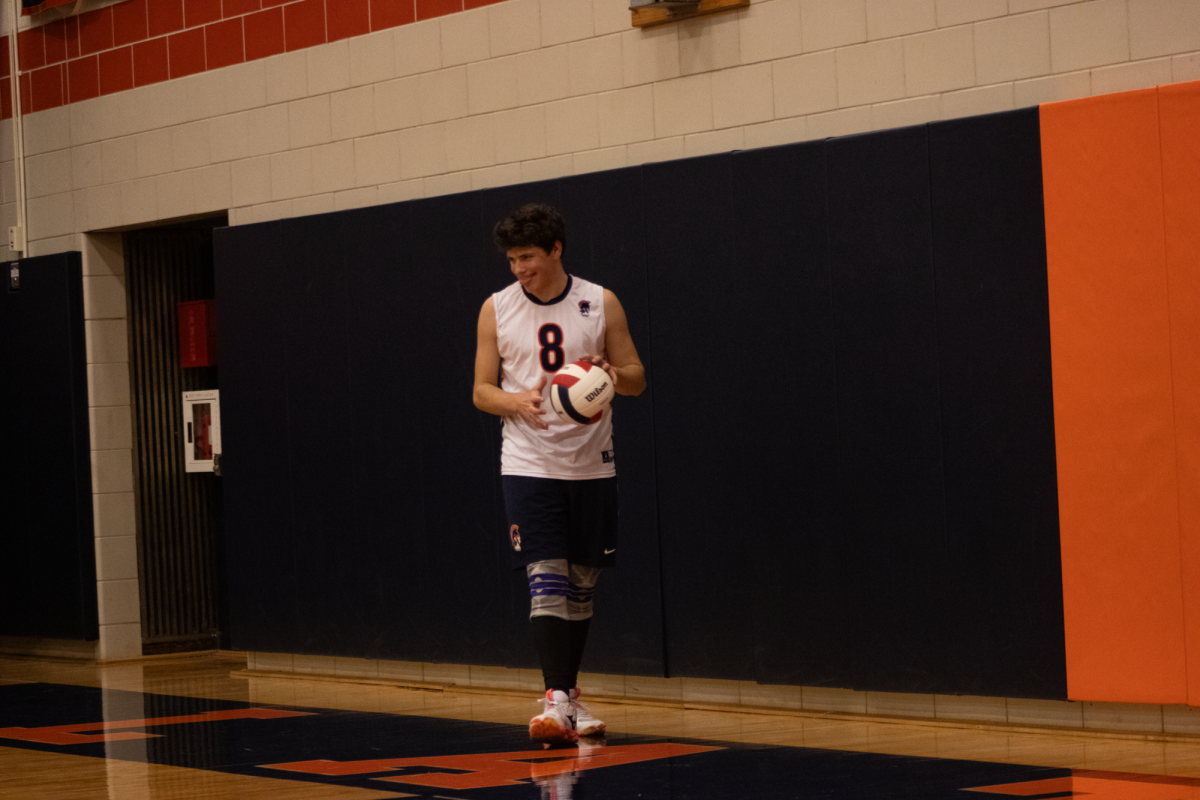








World-renowned cellist Yo-Yo Ma, legendary composer John Williams, and junior Gabi Raviv may seem like an unlikely trio—but all three have performed at the Chicago Symphony Center. Gabi recently qualified for the finals—and placed third—in the Crain-Maling Foundation CSO Young Artist Competition for his cello solo. The competition, often considered the most prestigious youth orchestra competition in Illinois, represents years of Gabi’s dedication.
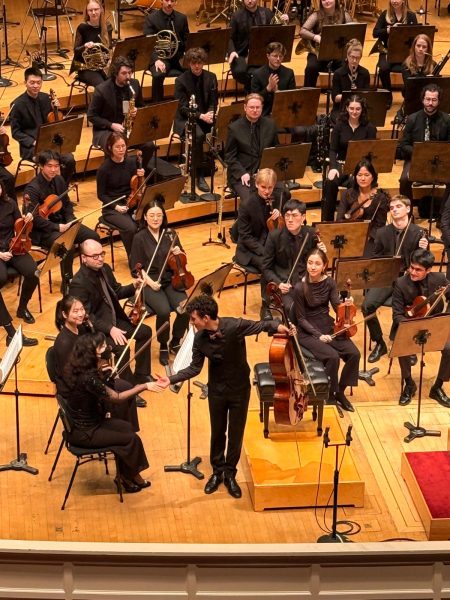
The finals, which took place in January, featured four soloists, each performing one song alongside the Civic Orchestra of Chicago (COC). “I was really honored,” Gabi said. “I’d been to Symphony Center my whole life to watch some of the most famous performers, soloists, and musicians play on that stage. To be able to have shared that stage and been on the same stage as some of the all-time great musicians—it’s truly an honor.”
That honor was not easy to achieve. The Crain-Maling Foundation CSO Young Artist Competition is a highly selective concerto competition for Illinois’ top young soloists. Each year, it rotates by instrument category; this year, it focused on strings.
Reaching the finals required months of intense preparation, as Gabi worked tirelessly to refine his performance. “I had been working towards this competition for months, and [qualifying for the finals] was a really good feeling,” he said.
“When I found out [that I was selected], I was actually with my family the night of the audition,” Gabi said. “I was totally shocked, because in the audition, my string popped in the middle of my performance, so when I came out of the audition, I thought, ‘surely it was over.’”
Despite the setback during his audition, his hours of daily preparation and consistency were enough to earn a place in the final round—an achievement stemming from years of dedication.
Music—the cello in particular—has always been central to Gabi’s life. “I first started playing when I was 4 years old,” he said. “My mom basically gave me the option of playing violin or playing cello, because my sister played violin and my brother was a cellist.”
But early on, that choice felt more like a responsibility. “I don’t think I ever would’ve considered [playing cello] as a hobby,” he said. “It was always something that was an everyday task—I had to go home every day and practice, which was something my mom always held me true to.”
With time, that routine evolved into something with a new meaning. Gabi said, “I think as I’ve gotten older, and I’ve become closer and closer to considering what I want to do in the future and study in college, it’s become more and more apparent to me that music is a passion of mine and is something that I want to pursue at a higher level than I am at the moment.”
Part of that growing passion came from the way the cello allows him to express himself. “The cello is the closest instrument to replicating the sound of a human voice,” he said. “The range is very similar, and the type of tone and quality you can get is very similar to a human voice, which I love because then I can hear someone singing, and I can emulate that with my instrument.”
Gabi’s musical development has been shaped not only by his passion for the instrument but also by the people around him.
“My brother has always been a huge role model for me,” he said. “I’ve always been chasing after him musically, just because of age, and I’ve always wanted to keep up and chase after him so I can play with him side by side.”
Gabi also credits his teacher with playing a major role in his development as a musician. “My teacher right now, who is the teacher at Northwestern’s Bienen School of Music, Hans Jensen, has been a huge mentor of mine,” he said. “He has been the ultimate motivator and person to guide my progression as a cellist. He’s known as one of the best cello teachers in the country, if not the world.”
“I can’t even explain how much extra time he gave me—he’s come off a plane from Toronto, come from a plane from Georgia, [to] be at Northwestern right from the airport to meet me, to help me play and give me extra lessons.
Beyond that one-on-one mentorship, Gabi has developed his craft through intensive training. For the past two summers, he attended the Meadowmount School of Music, a highly selective program located in upstate New York for young musicians. “[The program is] seven weeks, [and I am] practicing six hours a day—there’s not much else to do,” he said.
That level of intensity forced him to confront what pursuing music at a high level truly demands. “I knew I wanted to get better, but when I got there, I was really thrown into the deep end of what it really looks like to be a professional musician and what it looks like to balance music with school,” he said. “When I went to Meadowmount, and it was just music, I really got to embrace everything music could give, and I fell in love with it even more.”
Gabi began preparing for the Crain-Maling Foundation CSO Young Artist Competition after his most recent summer at Meadowmount. “It was definitely a process unlike anything I’ve ever done, because you have to get your piece to such a high level, and it's like there's step one, and step two, and step three, and step four, and you can’t get to step 50 until you get all the way up to step 49,” he said.
The intensity of his practice schedule only picked up once the school year began. “Since the school year started and until the competition, I only practiced the piece—[qualifying for the finals] was my goal, and I wanted it so bad,” he said.
Still, reaching that level of performance—through countless hours of practice and refinement—is easier said than done. “It’s not hard to make a piece [sound] good. You can get intonation, you can get everything objectively good,” Gabi said. “It's those final two weeks before your audition, where it's already good. It's so hard to just make it a little better, to get that final push to take you over the edge to really where you need to be at to maximize your performance.”
For Gabi, the process of perfecting intonation became rewarding in and of itself. “I thought [practicing the song] was a great learning experience,” he said. “I’m so grateful to be able to perform and play on that stage with that level of an orchestra, but the truth is, the real reason you play in these competitions is to ultimately continue to get better.”
That emphasis on progression continues to drive him forward. “Right now it’s all about progression, progression—how can I maximize my growth as a student every time I sit down to practice?” he said.
But beyond structured training, much of his journey has also been supported by those closest to him at Latin. “I definitely had the ultimate support system—I had friends at school at Latin, hyping me up for this performance when I was telling them about it, super supportive about it,” he said.
Junior and member of the Upper School Jazz Band Stofer Stineman was one of the people who showed up for Gabi. “I was really glad I got to go and support Gabi,” Stofer said. “A lot of people don’t realize how much work he actually puts in, so it was great to see him get recognized by the school—he definitely deserves it.”
Junior Lee Whiston, another friend of Gabi, also attended the competition. “What impressed me most was how professional and composed he looked on stage,” Lee said. “You could tell right away how much work he’s put in, just from the way he carried himself.”
Even with his recent success and recognition, Gabi is already looking ahead. “[Pursuing music beyond college] is definitely my dream,” he said. “I’m definitely going to pursue it in college, and the goal is to be able to do music for as long as I can, and to continue to make music with other people. I love it, it’s my passion, and I hope to do it for as long as I can.”
At the heart of that ambition is a simple idea—one that continues to strike a chord with him. “I’m a big preacher of doing what you love,” he said. “I don’t see a point in grinding something and taking a lot of time in something if you don’t truly love it. The things that make you happy and the things that you’re passionate about are things that you’re going to do at the highest level because you want [to], and that desire to do it well is going to come from you and not anybody else.”