

































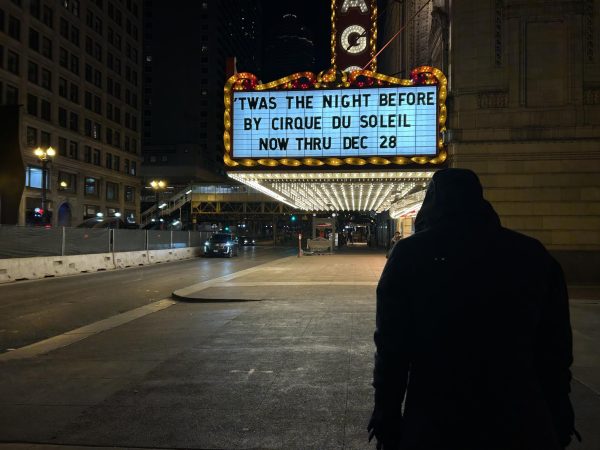
The Christmas tree lights glimmered downtown as families headed home, teenagers flooded the streets, and fights broke out. Latin juniors Hadja Barry, Kerry Koranteng, and Cali King stood downtown near the intersection of State and Randolph Streets on Nov. 21, when, suddenly, their conversation was interrupted by gunshots, screaming, and hundreds of people running away.
“After we heard what seemed like two rounds of gunfire, we ran away because we did not know if it was near or far,” Hadja said. Around 30 minutes later, Hadja recalled hearing “three or four gunshots. Boom, boom, boom, boom. Obviously, people were screaming and running, so we started to run.”
Following a teen takeover—a large, planned gathering of teenagers—where two shootings occurred after the annual Chicago Christmas tree lighting, Ald. Brian Hopkins announced on Dec. 2 that he planned to reintroduce an ordinance to the city council that would allow the Police Superintendent to impose a “time and place” curfew (a curfew that can be imposed on teenagers with a warning) whenever there is a perceived threat.
In response to an inquiry by The Forum, Ald. Hopkins said his short-term goal with this legislation was to “prevent deaths and injuries like we saw last month as a result of a teen takeover. Teenagers were brandishing tasers and threatening police officers, and that is wholly unacceptable and disgusting. A 14 year old was shot and killed as a result of being in the middle of one of these violent incidents.”
Although Ald. Hopkins hopes this “time and place” curfew will be implemented, he has faced obstacles imposing similar regulations in the past. Last June, one such ordinance sponsored by Ald. Hopkins, which set a 30-minute warning period for when teenagers should be in their homes, passed the city council by a vote of 27 to 23. However, Mayor Brandon Johnson vetoed the legislation, arguing that it failed to address the root cause of violence and could create tension between police and teens.
Ald. Hopkins said he thinks that the current proposed ordinance is the solution to preventing future teen takeovers. He explained how he altered the legislation to make it more appealing to the city council.
“This new ‘time-and-place’ curfew extends the warning, or public announcement period, to 12 hours, giving plenty of advance notice to minors and event organizers that a curfew will be put in place at that time,” Ald. Hopkins said.
Some disagree that the new curfew will improve city safety, arguing instead that the “time and place curfew” only places more restrictions on minors.
“A lot of these kids find their own and find comfort within the streets, so adding this new curfew that could take away [that comfort] will negatively affect them,” Hadja said. “They're going to find a new home either way; if it's not the streets, then it's going to be somewhere else, like a restaurant or a store. Kids are [likely] to do what they want, and I don't think people understand that.”
Sophomore Arlo Heltzer agreed with Hadja’s sentiment on teenage resistance, making him wary of the effectiveness of the curfew. “These kids are already committing way worse crimes,” Arlo said. “A [10 p.m.] curfew already exists for teenagers that they're obviously not following, [as evidenced by] the recent events, so what's going to make them follow this new curfew?”
The issue of following a curfew involves not only teenagers but parents, according to Ald. Hopkins, a parent of two 7 year olds and a 9 year old.

“Parents need to take a much more involved role in policing their own children's activity. It is disheartening when a police officer is forced to hold a 13- or 15-year-old child in protective custody because they are running around after 10 p.m. downtown,” Ald. Hopkins said. “It is not to punish [teenagers]; it is to protect them from harm that can happen late at night. Curfews exist for a reason, and this one permits younger people to enjoy our entire city while also addressing pre-planned gatherings that can turn violent. The government cannot be the only one addressing the issue. The parents and community need to play their own role.”
Elissabeth Legendre is an Upper and Middle School Latin teacher and parent of a teenager. Her son has evening volleyball practices, uses Chicago's public transportation, and occasionally bikes around the city, which makes following a “time and place” curfew seem difficult. Unlike Hopkins, she disagrees with blaming the parents; however, she does not see how enacting this new legislation is the correct approach to stopping violence.
“I don't think that this law is going to do anything but cause more hurt to communities that are already vulnerable,” Ms. Legendre said. “This curfew is just another way to police brown and black bodies.”
Additionally, Ms. Legendre explained that the violence that occurred at the Christmas tree lighting is not rooted in teenagers being out at night, but in the lack of federal gun laws meant to prevent shootings in the first place.
Although Chicago and Illinois have strict gun laws compared to many other U.S. cities and states, this fact does not prevent gun violence within the city.
“I hope that we could somehow discover or decide that we actually care about the lives of young people enough that the lives of young people are more important than having and owning guns,” Ms. Legendre said. “‘How do we deal with that?’—I think that is the better question that I would want my politicians to be dealing with and writing laws about.”
Hadja agrees with Ms. Legendre and Mayor Johnson that the “time and place” curfew is not the way to tackle violence. She believes targeting the root causes of this violence is what legislators need to focus on.
“In order to make the city safer, we need to start with the younger generation, so that when they grow up, they can understand how their actual actions affect everybody else,” Hadja said. “We need to educate them on more positive [and] safer ways to go about certain things instead of resorting to violence in the streets.”