







































Fantasy football isn’t just a game; it’s a hidden classroom, with concealed complexity that makes it one of Latin’s favorite pastimes.
In fantasy football, players draft real NFL athletes to create virtual teams, earning points each week based on their performances. Managers make trades, set lineups, and compete to outscore their opponents, turning football into a game of math and strategy. Behind the drafting and punishments lies a world of statistics and decision-making.
With each season bringing new leagues and NFL rosters, fantasy football constantly demands fresh strategies, making it both mathematically complex and endlessly adaptive.
Even at the student level, math plays a key role in shaping fantasy football decisions. Sophomore Liam Calvert uses math to get ahead in fantasy football. He focuses on spotting real patterns to make smarter decisions when setting his lineup.
Like many fantasy players who rely on strategy over luck, Calvert explained that consistency matters more than one standout week. “I look at how many weeks they have done it,” he said. “If someone scores a lot, that's probably luck. But if they keep doing it, that's more of a pattern. In math, we talk about outliers, so one crazy week doesn't really change the data that much.”
As analytics continue to grow in popularity among fantasy football enthusiasts, detailed statistics enable the development of better strategies. Players can analyze yards gained or touchdowns to determine the best players to draft.
While many players use statistics to gain an edge, some have transformed fantasy football into an art of precision. Chris Eibl is one of them, a hall of fame fantasy football player who has won approximately $500,000 in National Fantasy Football Championship (NFFC) leagues.
Eibl’s love for Fantasy Football began in sixth grade, when he spotted a fantasy football magazine on a store shelf. Curious, he decided to mail in a $50 entry fee to the man running the league. Eibl’s decision to join the league paid off, and within three years, he had accumulated over $1,000, which motivated his passion for the numbers and strategy behind fantasy football.
Throughout his time playing fantasy football, Eibl has used the same firmly grounded data-driven approach.
Eibl discussed his methodology in an interview with The Forum. He said he uses a “simple yet effective method of calculating how much provides over the league average,” then he “compares that to the player’s ‘average draft position’ to determine whether or not it makes sense to draft that player at his pick.”
Eibl employs this strategy for almost every draft to ensure that he doesn’t pick someone earlier than necessary, and to identify good value quickly when needed.
In auction drafts, each team has a fixed budget to spend on players during the draft rather than selecting players in a snake order (where you take turns drafting a player to your team). Eibl applies the same principles in these drafts to avoid unnecessary spending on slightly above-average players and instead looks for value players who have high potential returns.
In addition, Eibl said that “staying up to date on rosters is incredibly important”—by closely studying depth charts and injury reports, he is always prepared to act when a key player goes down.
Another central piece of advice that he gives to managers looking to improve their game is to “stay up to date on the waiver wire” and to consistently “replace players who don’t have upside on your bench with those that do.” For Eibl, success in fantasy football doesn’t come from instinct but from preparation, probability, and disciplined decision-making.
Similarly, his approach reflects the same logic found in Latin, where success relies on his precision and strong commitment to his methods. Both Latin students and Eibl rely on focus, consistency, and problem-solving, which shows that the mindset used in the classroom can also lead to success in fantasy football.
But while Chris Eibl showcases the heights of football mastery, sophomore Grant Coady claims that one doesn’t need to be a football expert to succeed in fantasy football. “I don’t know much about fantasy football; I just play because my friends also play,” he said.
His success comes from a data-driven approach. He analyzes each player's statistics, focusing on average fantasy points and consistency rather than relying on touchdowns, which are unpredictable week to week. “I don't know much about football,” he said, “but I'm top three in my league because I trust the numbers rather than the names.”
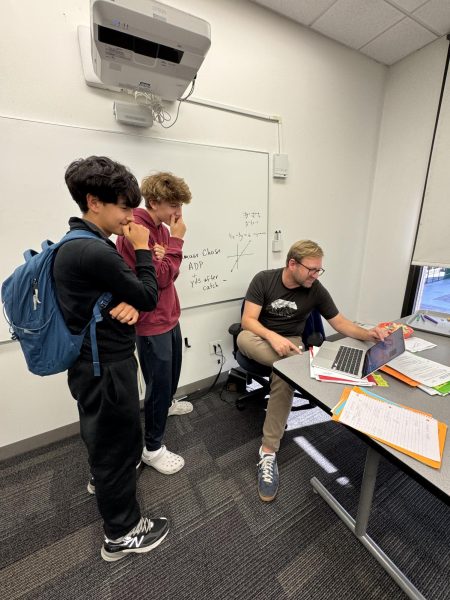
Even teachers see this same connection between math and fantasy football. Upper School math teacher Zach McArthur views fantasy as more than just a pastime; he sees it as a lesson in strategy and statistics, specifically when it comes to drafting his team. “I try to figure out how much the best player available is better than the next best available player,” he said. “Just the numerical spread isn't enough. I also try to think about which positions have more good players than others.”
One way Mr. McArthur views fantasy football is as an engaging way to connect students with mathematical ideas. “I think fantasy football could be a vehicle for lots of statistics,” he said. “Each player's predicted points each week really is the average of a large range of potential outcomes. Standard deviation would be a nice thing for students to explore there.”
Fantasy football demonstrates that success comes from strategy and analysis, not just knowledge of the game. Whether it's Eibl's meticulous drafting, Grant's data-driven choices, or Mr. McArthur’s classroom insight, the best players are those who plan carefully and make informed decisions every step of the way.