It’s late at night. You sit down at your desk and open your backpack. Sigh. You look at your Canvas to-do list and see that you have a 23-page reading for U.S. history, a major speaking assessment in Spanish, and your lab write-up for AP Chemistry on ideal gas law—all due the next day. Not to mention a Precalculus test, first thing in the morning.
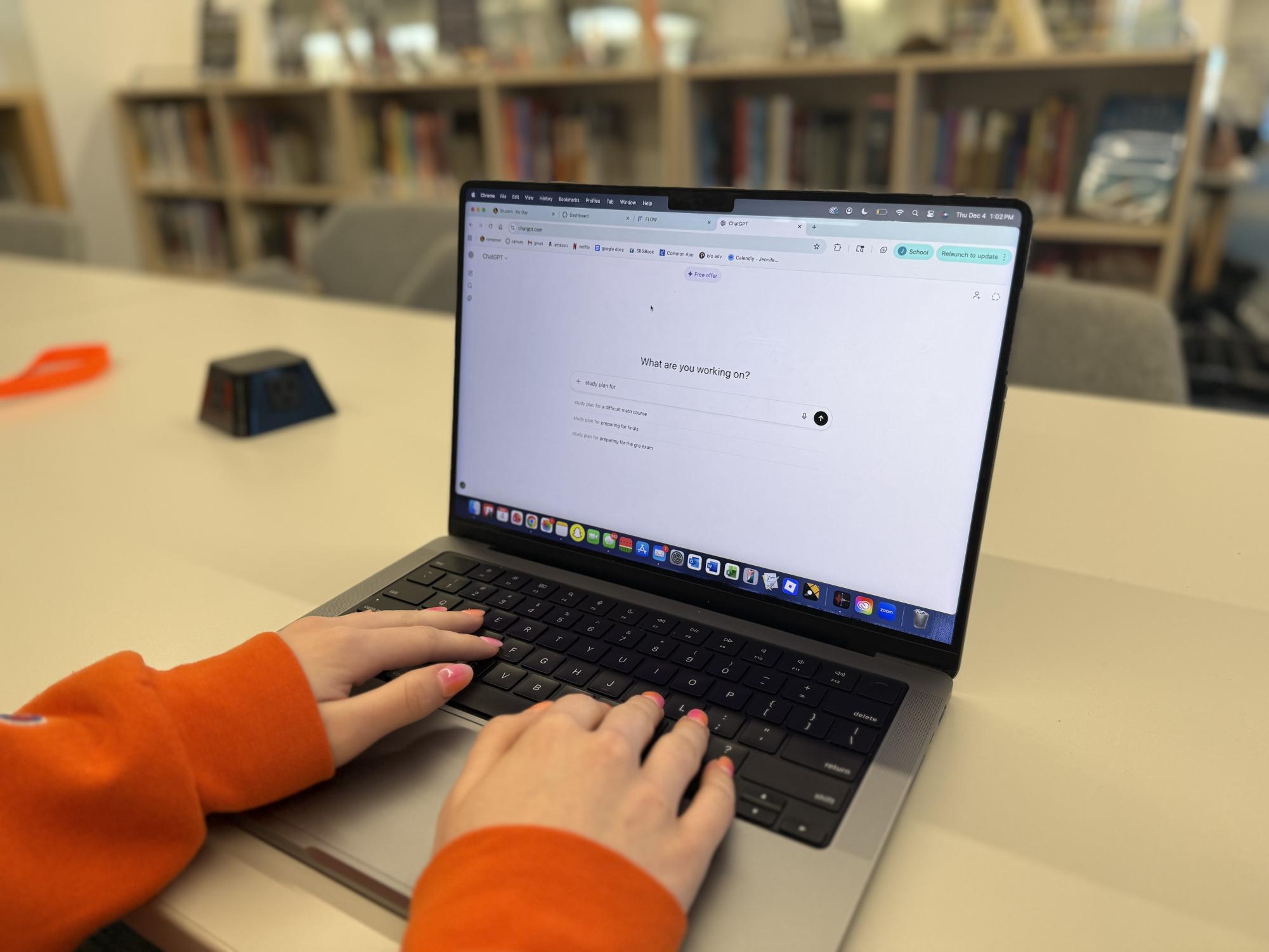
To lighten your load, you turn to artificial intelligence. You use it to break down dense historical writings, generate potential assessment questions to help you prepare, organize your notes before getting started on your write-up, and transform your study packet to create varied and challenging practice problems.
Whether they’re asking AI to generate a problem set or simplify textbook material late at night, many students at Latin are experimenting with AI as a study tool. However, while this technology seems new, quick, and highly convenient, teachers are raising concerns about whether it’s actually helping students learn.
No two departments have the same views. Across the school, teachers are split: Is AI a helpful technology that supports students, or is it taking away essential steps in the learning process? Some believe that AI opens exciting possibilities for new strategies, while others think it hampers the development of key skills and even threatens core values of education.
Some of these differences become apparent for each academic department.
The Math Department has many concerns about the use of AI as a study resource. Math teachers emphasize the process, precision, and struggle required to understand and apply their subject. Using AI as a shortcut can eliminate real problem solving and weaken understanding; it creates worry among teachers that students won’t be able to think through their mistakes.
Upper School math teacher Michelle Neely voiced this skepticism. She is not an AI user herself, preferring vetted sources, but she is aware of colleagues in her office who use it to create complex problems for in-class work. Her primary concern is that students who use it will lose an essential part of the math process: working through errors. “I want them to figure out what they did wrong,” she said. “I don’t want AI to tell them.”
Ms. Neely compares students’ overdependence on AI-assisted studying to society’s reliance on GPS, creating a laziness that harms critical thinking skills.“It’s a really lazy way to get from one place to another,” she said. “We’re moving toward ‘WALL-E.’”
Despite her worries, she still acknowledges potential benefits of AI study habits. She likes that it creates complex and challenging practice problems, and the novelty of this technology can motivate students to study more. But those advantages still come with a warning. “Use it as a fourth-level add-on, not the first thing you go to,” she said.
Members of the Science Department take a slightly different view than Ms. Neely. Some science teachers see AI as potentially useful, but only in specific contexts and for particular uses, and only if it isn’t used to replace students’ analytical thinking.
Upper School science teacher David Wisnieski, who teaches Honors Biology and Marine and Aquatic Science, has been seeing firsthand how AI has been integrated into the materials in his classes. The Honors Biology textbook, for example, recently added an AI feature, and he is inclined to trust it over other AI because its knowledge is limited to the textbook rather than to outside sources on the internet.
However, he stresses that good learning still requires active engagement with the material. “I think the most valuable part of using AI comes before the tool ever gets involved,” he said. “When students write their own summaries first, they actually learn the material. If they skip that step and let AI do it for them, it becomes passive studying—and that’s just not as effective.”
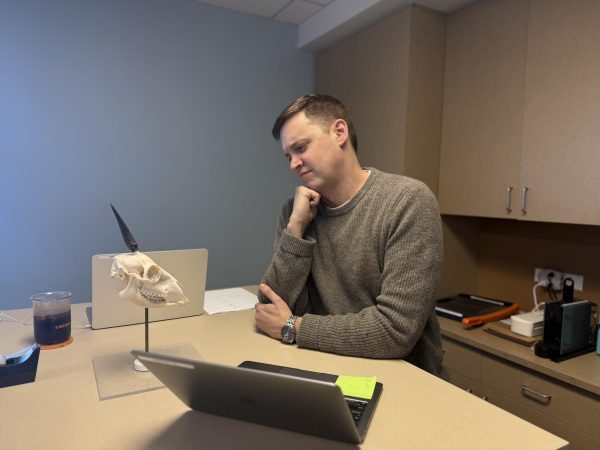
Mr. Wisnieski also worries that AI could harm students by allowing them to bypass the analytical thinking process that science, similar to math, requires. “I’m open to AI being a tool, but I don’t think it should replace the struggle; that’s part of learning science,” he said. “Sitting with the data, talking with group members—that’s where real understanding happens.”
Mr. Wisnieski believes that students need to be more cautious in their use of AI, even for studying, because it doesn’t always align with the direction the student should be headed given the carefully chosen materials in their curriculum. “AI is not smart,” he said. “It’s looking for associations and patterns.”
While math teachers worry about lost reasoning, and science teachers worry about lost analysis, the English Department focuses on the loss of student voice. English teachers try to help students develop their personal writing styles and original ideas, but AI could flatten that progress, encouraging robotic-sounding language and structures.
Upper School English teacher Katie Jones has experimented with AI in her classes by using it for background research for novels, and has even asked students to use AI to check their poetry drafts for cliches. But she understands AI’s limitations on creativity. “AI often mimics the sound of a good idea, without actually having a good idea,” she said.
She worries that when students become reliant on AI as an editor or an expert on structure, they will lose the opportunity to grow the interesting aspects of their individual writing style, harming their linguistic skills. AI varies in the quality of its feedback and ideas, and although its grammar tips often prove correct, those tools cannot replace the process of students thinking, revising, and learning how to write on their own. “High school might be the last chance students have to really learn how to write,” Ms. Jones said.
She also expressed concerns about the thin line between ethical use of AI and academic dishonesty. “I’m a teacher, not an FBI agent,” she said, emphasizing that she doesn’t want to have to police students’ AI usage.
The History Department takes an extremely cautious approach, seeing few benefits to support AI use. They stress that understanding the past requires critical thinking, synthesis, and analytic skills that can’t be developed as effectively when students outsource the way they gather knowledge.
Rather than rejecting AI entirely, history teacher Ernesto Cruz wonders whether the tools students are using now actually support learning. Mr. Cruz worries that students turn to AI before they have the skills needed to judge and understand its response. “AI is good if you can do the thing yourself,” he said. “If you can’t do the thing yourself—and it’s the thing you need to be able to do—that’s the concerning part.”
Without the foundational skills needed to comprehend AI’s responses, students who use it can reinforce misunderstandings rather than correct them. “There’s a whole lot of work students need to do before they can evaluate what AI gives them. Right now, I’m seeing a lot of garbage in, garbage out,” Mr. Cruz said.
The History Department is hopeful for the future of AI, preferably in a different form. Until then, however, they remain wary of the harm AI can cause, replacing the critical thinking process the subject demands.
A common concern across departments is the massive environmental toll AI takes, consuming enormous amounts of energy and water for each prompt processed. “I struggle using it in an environmental science course, knowing its environmental impacts,” Mr. Wisnieski said.
Ms. Neely urges students to consider different tools that leave a smaller environmental dent. “I am a little bit of a tree hugger, Earth muffin, environmentalist, and I just hear that the amount of energy that is being used for AI when we have other resources that seem far less energy-reliant,” she said. “Why would we do that?”