


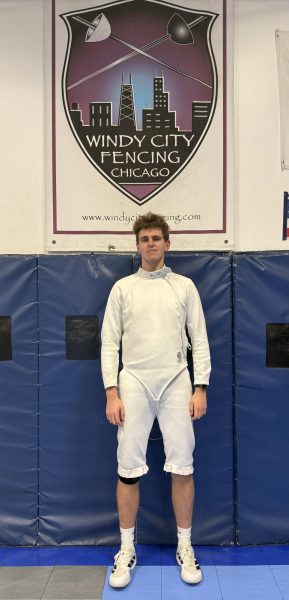
En garde! Senior Theodore Tikhomirov earned recognition as a Coca-Cola Scholars semifinalist this October, an organization that selects top high school seniors who demonstrate leadership, service, and commitment to positive impact.
Theodore’s work with his nonprofit Fencing for a Purpose (FFP) earned him a spot among the top 1,300 out of 100,000 Coca-Cola Scholars applicants nationwide.
Fencing for a Purpose was launched in May 2023, when Theodore and two of his fencing peers recognized the sport's accessibility issues and its potential to become more popular. In two-and-a-half years, FFP has grown to have international partnerships, fencing camps for children, and a team of 40 members.
In the early stages of FFP, Theodore had the opportunity to meet Ukraine’s national 17-and-under fencing team. He began talking to their coach, who showed him how athletes practiced during the Russia-Ukraine war.
“They didn’t have lights, so they took the flashlights on the back of their phones and taped them up on the wall, so you can get at least some light to run a practice,” Theodore said.
After seeing the conditions the fencers practiced in, Theodore asked the coach if there was anything his organization could do to help out, to which she responded, “A lot.” Theodore said, “That was the moment I realized our organization could make a real impact.”
Following the camp, FFP co-sponsored Ukraine's U17 and U20 national championship teams and equipped the top three athletes with international-grade blades. After shortages and economic troubles following the onset of the war, many Ukrainian fencers could no longer afford the necessary equipment for the sport.
Moreover, FFP funded travel for around 70 youth fencers to attend the world's largest youth fencing tournament in Poland.
Windy City Fencing coach and the first three-time NCAA champion in women's épée Ania Garina has seen firsthand what FFP’s support means.
“I grew up fencing for Ukraine, so seeing Theodore start a foundation to support Ukrainian athletes means so much. I'm sure that for a lot of those kids, it's one of the only places life feels normal to them,” she said.
FFP also runs camps to introduce fencing to disabled youth. Theodore reflected on his time working with a child who has a disability and described the power of para-fencing, commonly known as wheelchair fencing.
“Para-fencing, in my opinion, is one of the best para sports because it maintains almost all of fencing’s mechanics. You can bring the sport to someone with minimal modifications,” he said. “Had I not started this organization, I wouldn't be able to bring my sport to someone else who, otherwise, given their situation, probably would have never been able to experience something like that.”
One moment that stuck with Theodore was when a girl was struggling with the fencing basics and had a shy demeanor. “As the camp progressed, she started figuring out the sport for herself. You can even tell that she was enjoying it more, and I actually see her in my club from time to time,” he said.
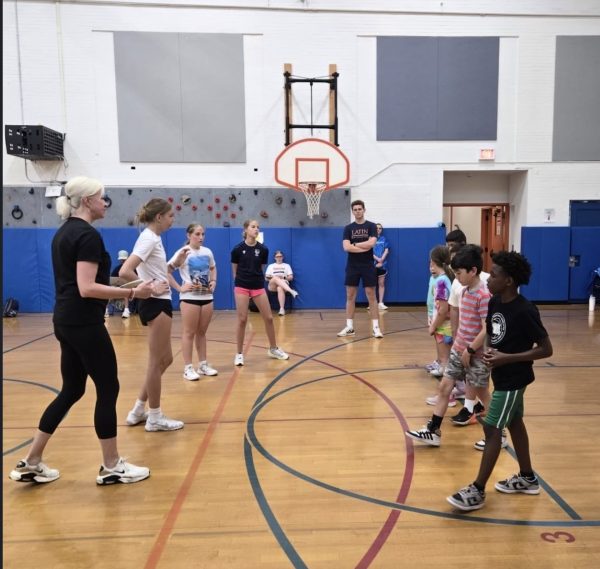
Sophia Talandzevicius, an eighth grader who also fences at Windy City Fencing, tutors Ukrainian fencers in English over Zoom through FFP and recently helped run a demonstration for Latin’s Lower School.
“Seeing Theodore start and run this whole nonprofit makes me think that I can do something like this, too,” she said. “I used to think you had to be an adult to make something like this happen.”
As his peers watched the organization grow, many of them noticed Theodore's leadership and drive. “Theodore is always thinking of ways to help others in his own way,” senior Grayson Hoffman said. “He speaks up in class and voices his thoughts regularly. Theodore leads by example.”
As FFP grew beyond an idea and toward a functional organization, the behind-the-scenes work became significantly more demanding. Theodore recalled the process of starting a nonprofit. “The biggest challenge was realizing how much I didn’t know,” he said. “It's really hard to go from ‘I have an idea’ and then to ‘I have an organization.’”
Building a nonprofit for the first time comes with a steep learning curve as well as the mastery and application of new skills. “How do you do graphic design? How do you make a flyer? How do you market something? How do you reach out to donors?” he said. “That's not something you necessarily consider when you think, ‘I want to make fencing more accessible.’”
Ms. Garina, who also supported the Lower School event earlier this year, sees Theodore's skills extending beyond fencing. “Aside from being a strong fencer, he is an amazing organizer and creates clear goals,” she said.
For Theodore, seeing FFP evolve into an organization that impacts many people is very meaningful to him, making his Coca-Cola Scholars recognition even more rewarding. “I see my Coca-Cola Scholars semi-finalist result as an affirmation of all the work that I've put in,” he said.
Theodore believes FFP, and the skills he has learned from it, have room to grow even after he goes off to college.
“After I graduate,” he said, “I want Fencing for Purpose to keep going at the same pace, not slow down.”



Theodore Tikhomorov • Jan 7, 2026 at 9:54 am
Now a regional finalist!!!!!!!!!! Yay!!!