


Editor’s Note: After this article was written, the U.S. Attorney’s Office filed a motion in mid-March 2026 to dismiss the federal charges against Catherine “Cat” Sharp and one other individual involved in the Broadview protest case.
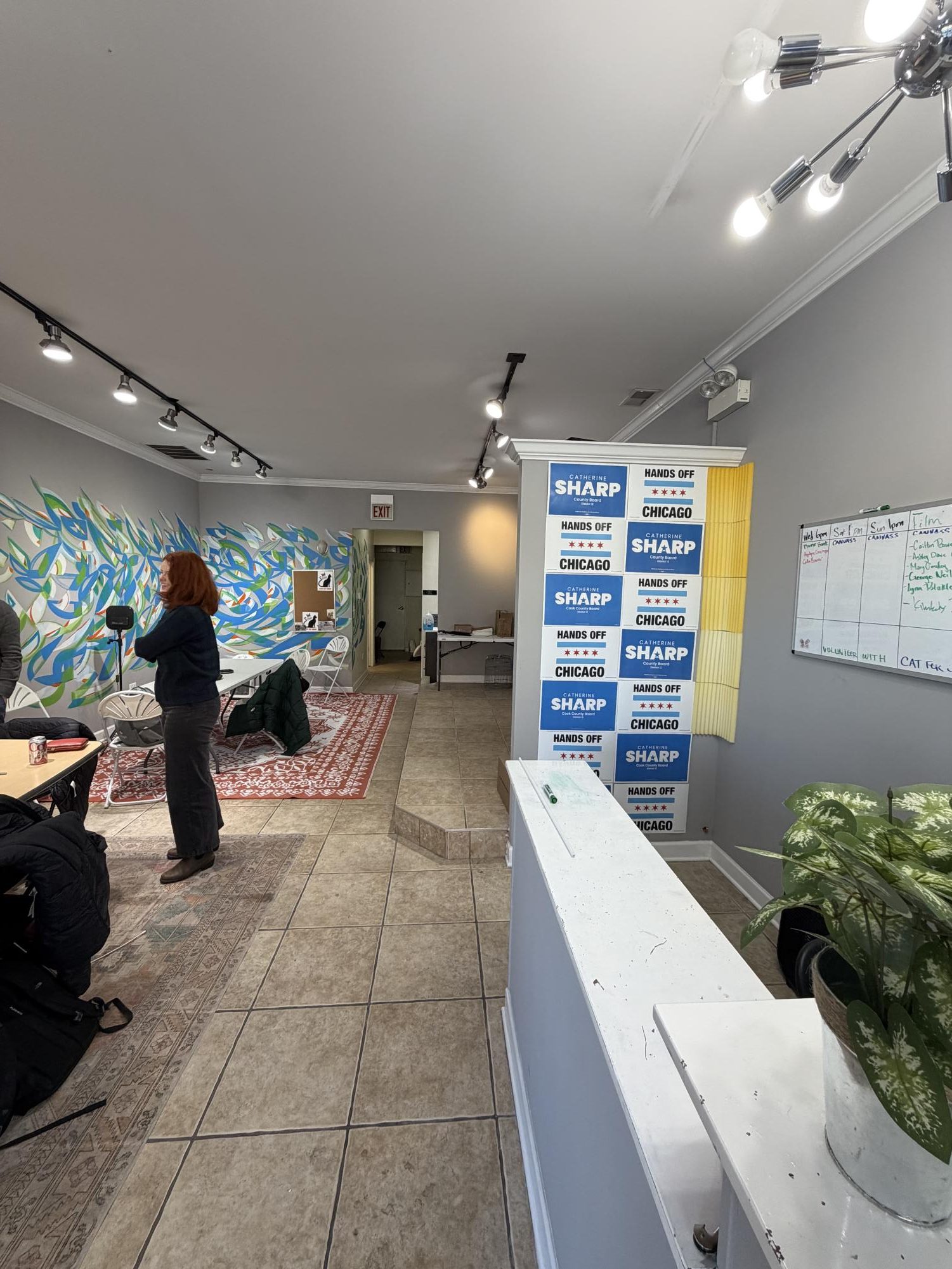
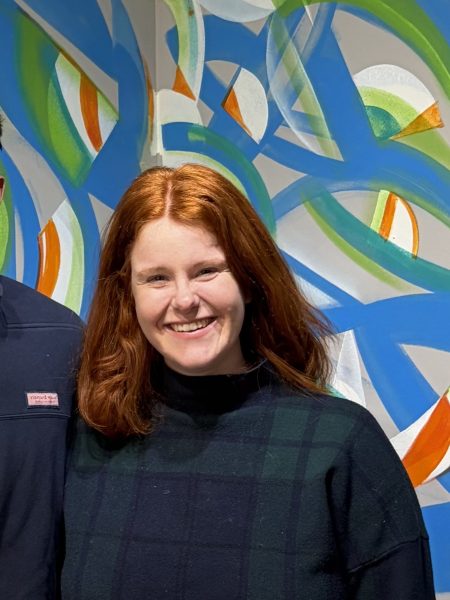
Catherine “Cat” Sharp ‘14 thought she might end up on a comedy stage. Instead, the Latin alum found herself on a ballot—and, unexpectedly, now navigating a federal legal case. Sharp, a lifelong Chicagoan with family roots in the city, recently launched and then withdrew from a campaign for Cook County Board, as she responded to a federal indictment connected to her participation in immigration rights protests.
A Princeton University graduate who spent her prior years at Latin immersed in theater and comedy, Sharp found her path shift dramatically when politics began to feel like a calling. “I ended up getting really politically activated in 2016,” she said. “I was already studying politics and felt like I just was not doing enough.”
That sense of urgency soon translated into action. Sharp moved into on-the-ground organizing, joining then-candidate J.B. Pritzker’s first gubernatorial campaign in 2018 as a field organizer.
“My whole job was to recruit people: to help knock on doors, make phone calls, and do direct voter contact, really speaking face-to-face with people,” she said.
The campaign, as a result, furthered Sharp’s curiosity about policymaking. “Campaigns are really important to get good people elected,” Sharp said, “but I also wanted to know how you push forward legislation.”
However, Sharp first began grappling with questions about real political change during her time at Princeton. Before working on campaigns, she stepped into organizing by advocating for equal access to student mental health services.
“I didn't feel like [Princeton] was doing enough to support folks in mental health crises, and I also had my own challenges, like accessing health care there,” Sharp said. “That was a big focus for me: seeing how I could organize other students into making real change that could help [not just] me, but help other people in similar situations.”
Working alongside other students, Sharp helped push the administration to expand mental health services on campus. “There had been a really significant waitlist for people trying to get free mental health care,” she said. “And, at least temporarily—before COVID happened—the school was able to significantly reduce the wait times of the backlog for [mental health] cases.”
That experience marked a turning point. “That was the first moment where it clicked for me,” Sharp said. “If I just talked to enough people, and reached out to the administration, we could make real institutional changes that actually benefit people.”
This understanding shaped Sharp’s decision to step into electoral politics herself. When she launched her campaign for Cook County Board, she said she was motivated by a desire to confront policy questions affecting residents across Chicago, particularly around housing affordability and property taxes.
A central focus of her platform was the city and county’s property tax system, which Sharp argued has placed increasing pressure on longtime residents. “The challenge that we’ve seen in this past year is that bills have gone up dramatically for residents,” she said. “In some neighborhoods, they’ve gone up by 100 or 200%.”
She pointed to corporations receiving lower property assessments, which shifts the tax burden onto homeowners and drives up assessments for surrounding properties, often forcing longtime residents out of neighborhoods they have lived in for decades.
Sharp also criticized the distribution of tax relief across the city. “The Board of Review has given really, really significant tax cuts to downtown commercial properties,” she said.
With fewer people working downtown and higher vacancy rates, she believes those reductions pivoted the burden elsewhere—often onto longtime Chicago residents. “Some of the cuts that were given to those commercial businesses were so significant that the cuts shifted the whole rest of the bill onto residential property owners and onto everyone else in the [city].”
At the core of her housing concerns, she said, is transparency. “I think it’s really important for people to know how the system works, because it’s super confusing,” Sharp said.
Her advocacy has also taken a more public form. Sharp has been involved in organizing and attending protests outside the ICE detention facility in Broadview, a neighborhood west of Chicago.
“They’d been holding people in [the Broadview location] for days, which they're not supposed to do—Illinois law prohibits ICE from having a detection center,” Sharp said. “This space is not supposed to be a detention center, but they've been using it as one, where they have all the doors and windows boarded up. There have been reports that there are people being held in overcrowded rooms where there's an overflowing toilet; the lights never turn off, and people have to sleep on the concrete floor in the clothes that they were detained in.”
Sharp participated in multiple protests at the site as part of a broader effort to protect the rights of detained immigrants. She said the reported conditions informed her decision to demonstrate. “They're not given adequate access to medical care or to food,” she said. “It is very clear that there are human rights violations that are happening there.”
Last October, Sharp’s efforts took on new legal consequences. “I was notified that there was a warrant for my arrest related to one of the protests,” Sharp said. She and five other activists—known as the “Broadview Six”—were later federally indicted.
Despite the ongoing case, Sharp says her commitment to advocacy has not wavered. “We can keep our neighbors safe and make sure that their human rights and constitutional rights are protected,” she said. “I’m not going to let the indictment intimidate me from doing that work and [from] making sure that our neighbors are safe and healthy, and that their rights are protected.”
When Sharp entered the race for the Cook County Board, she framed her campaign as an extension of the work she had already been doing with immigrant rights and housing affordability through door-to-door outreach.
“When I launched this campaign for the Cook County Board back in the summer, I said I was running because we need principled, bold leadership at the local level at a time when our communities are under attack from the federal government,” Sharp said.
At the time, she said, she did not anticipate how quickly those pressures would become personal. “I had no idea how true that [commitment to bold leadership] would prove to be over the last several months.”
Sharp characterized the charges against her as an attempt to silence organizers and quash dissent. “I know that we will prevail against these unjust, ridiculous charges, which were designed to force people like us to sit down and shut up,” she said in an email to subscribers. “I’m ready to continue that fight, because I know it’s what is required of me and all of us in the face of the inhumane, brutal treatment of immigrants and refugees.”
Nonetheless, Sharp said the realities of navigating an ongoing federal case forced a reassessment of what she could bear. “Navigating this unimaginable legal process—and all the costs, emotional and financial, that come with it—has made running for office much more difficult,” she wrote in the same email. “As a result, I feel that the most responsible decision for me is to suspend my campaign for Cook County Board so that I can focus on winning the legal battle.”
But even as her campaign has been suspended and the legal fight continues, the impulses that have guided Sharp’s career—questioning systems and refusing to look away from injustice—were formed long before the courtroom or campaign trail. For Sharp, that conviction traces back even further—long before Princeton—to her years at Latin.
“I had some really amazing teachers at Latin, and I took some really amazing classes,” Sharp said.
One course in particular shaped how she later understood protest and the risks of political complacency. “I had taken the Nazi Mind course, which I think was really important,” she said. “So much of that class is focused on how a society allows for the rise of fascism and violations of people’s human rights and civil liberties.”
Years later, as Sharp’s own activism placed her in the public eye, those lessons felt less theoretical. Her story has drawn significant attention from the Latin community, prompting conversations among students and faculty about what it means to stand up for one’s beliefs and what civic engagement can look like for students.
Senior Ralu Nzelibe, who serves as the Senior Prefect of the Student Government and plans to attend Princeton University, said Sharp’s story feels especially touching. “When I hear about people who are activists, I go back to my mom,” he said. “My mom is a person who works with immigrants, especially young people, as an immigration lawyer, a pro bono lawyer.”
Ralu’s personal connection, he said, informs how he understands activism. “These types of actions, where you stand up for people that don’t have a voice—not even specific to college or high school, but as an American—it's so important to do that. Civic engagement is one of the most important tenets of our country and national identity,” he said.
Upper School history teacher and advisor to Student Government, Model Congress, and the We Will Vote Club, Debbie Linder, also sees Sharp’s story as both inspiring and revealing about Latin’s environment surrounding political discourse. “There are too few kids in our school who know how our systems work,” she said.
Ms. Linder believes that civic literacy should be more accessible to students, with the goal of encouraging advocates like Sharp. “I think that we should create a class—it doesn't have to be for seniors, it could even be a sophomore elective—where kids have a chance to take civics and get to know how our system works, and not just at the federal government, but looking at [cities] and states.”
Beyond advocating for change in the curriculum, Ms. Linder also sees a lesson in Sharp’s example.
“I think there are a lot of kids at Latin who would love to have the ability to speak out, but they don't feel like they have the ability to do that because they're worried about how they're going to be perceived,” she said.
For Ms. Linder, that hesitation among students sheds light on a broader tension in civic engagement among youth. “I think one thing I hope the [students] will realize is that it's a privilege to take a risk,” she said.
Sharp knows firsthand what those risks can look like. Even as she steps away from her campaign and navigates an ongoing federal case, she has continued to represent civic engagement as an opportunity for people of any age to make change.
For current Latin students, Sharp emphasized that civic engagement should not be distant—it’s something they can actively participate in and shape themselves. “I think Latin kids are really specifically engaged and really talk a lot amongst each other,” she said. “I would encourage folks to get involved with campaigns—learn about knocking on doors, reaching out to many people, and having face-to-face conversations with people outside of your bubble.”



Chris Williams • Apr 7, 2026 at 1:32 pm
Awesome article Rohin. It was great to learn more about an advocate/organizer/candidate like Sharp… specifically, her journey to where she is today.
Deborah Linder • Mar 6, 2026 at 8:11 am
Brilliant article, Rohin. I hope that Sharp’s work inspires others to take action. I also hope that she considers running for office again sometime in the future.