The Israel-Hamas war reached a turning point with the hostage release on Oct. 13 and the agreement about steps toward rebuilding and stabilizing Gaza. This milestone has provided an opportunity for Latin community members to reflect on the past two years, and students and faculty are using this moment to examine the school’s response to the war and what they have learned about handling difficult topics as a community.
Israel and Hamas have been engaged in a war since Oct. 7, 2023, resulting in mass casualties and destruction on both sides. Recently, a ceasefire agreement led by the U.S. government resulted in the release of the 20 Israeli hostages remaining in Gaza. However, conflicts between the Israeli government and Hamas caused a recent return to warfare.
With its immense death toll and heavy cultural significance, violence in the Middle East affects many people beyond the region, including many in the Latin community. And not surprisingly, given the intense feelings about the conflict, some community members have expressed dissatisfaction with how the school has handled conversations about the war.
Since the initial conflict began, certain faculty members felt that the school lacked resources to hold discussions about these topics. Upper School history teacher and Difficult Dialogues advisor Matt June said, “There are learning opportunities and sharing opportunities related to anything, but particularly to the events around Oct. 7. I do not think [the school was] prepared, when the attacks of Oct. 7 happened, to productively do the sharing part of that.”
At the beginning of the war, the administration took a more objective approach, which aimed to present only facts and not offend any students. Senior Hiba Ahmed, a Muslim student, explained how this method lacked depth and empathy. “Objectivity removes emotion from these types of conversations,” she said. “A lot of this war relates to identity and who to blame, which shatters the objective perspective.”
The objectivity made some students feel unable to express their perspectives. Dr. June said, “I think that students rightfully felt like they did not have opportunities to share [their] perspectives, and, more importantly, their feelings about what was happening.”
Upper School history teacher Jeremy Goodman, who teaches the sophomore history elective Middle East, examined why people struggle to have conversations about the war. “If you're talking about this conflict without [a] historical basis or historical understanding, in my view, it's really challenging to understand what's happening today,” he said. “If the first thing that somebody learned about this conflict was Oct. 7, then you're not starting on really solid footing.”
With many different educational backgrounds about this topic, many people approach conversations without full awareness of what their words mean to some peers. “Some people just aren’t educated on the topic, others may be scared of saying the wrong thing, and some are just ignorant,” Hiba said.
Ignorance—amplified by dual-sided misinformation and media bias—can manifest as hate and bigotry. Senior and Jewish Student Connection head Ariel Goodman said, “The amount of violence toward [Jewish people], including myself, is a horrible feeling. It is scary to be Jewish in America at this time.” Recent events and statistics reinforce this fear: The highest ever number of recorded American antisemitic events in a single year occurred after Oct. 7, with a total of 9,354 reported incidents.
Additionally, 8,658 incidents of Islamophobia were reported this year in America, the largest number since 1996. And yet, individuals in both groups have had to grapple with questions of identity and political reality. “I think, specifically, [that] there is tension between Muslims/Palestinians and Jewish people,” Hiba said.
Beyond a lack of quality and an intense tension within these conversations, students and faculty have noticed a broader issue: Classrooms simply don’t discuss the history or current events relating to the conflict in the Middle East. Junior Finn Parr said, “I haven’t experienced any conversations in my classes about the topic.”
Mr. Goodman agrees that there hasn’t been a lot of dialogue about the Middle East in classrooms at Latin. “My [Middle East] class is probably the only class that I'm aware of where [the war] is actually [talked] about in educational settings,” he said. “It's a scary thing for educational institutions to really even address this topic, because it's kind of inviting controversy, but I think it's something that we should do and that the school should try to make spaces for.”
Hiba provided ideas on how the school could have improved. “Latin could have done a better job acknowledging that this war isn't only affecting one particular identity,” she said.
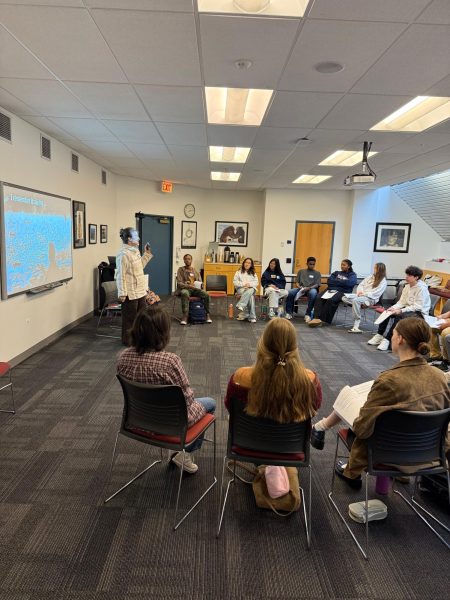
Dr. June has worked to incorporate community feedback. “We've started Difficult Dialogues, not just in response to [the Israel-Hamas war], but in terms of thinking about how we can create an infrastructure [to hold these conversations] … [and] be thoughtful about the ways that those [conversations] are happening,” he said.
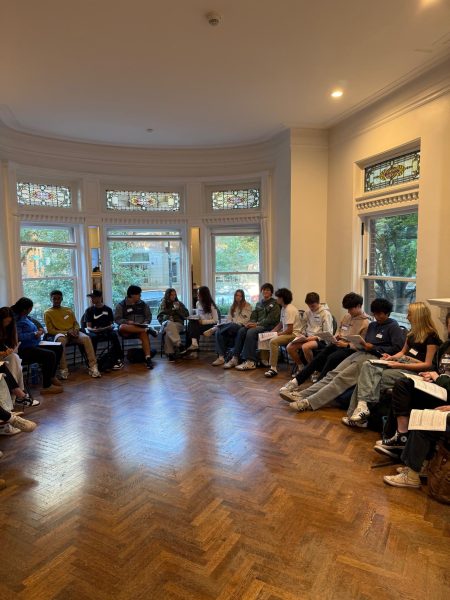
While Dr. June had facilitated dialogues in years prior, the student Difficult Dialogues Council was formed last year to address many students' concerns about holding meaningful discussions in a tense political and social environment.
“It's less about how to talk about things and more about learning how to listen to others,” he said.
The idea of learning to listen gives many students hope that the Latin community can strengthen its ability to cope with hardships together. Hiba said,“I hope we can [all] come together, and break [the] tension to understand one another.”
Senior Ellie Falk, a Jewish Student Connection head, agreed with Hiba, saying, “As the hostilities unfortunately continue, I have realized how important it is that everyone shows up for each other and recognizes that we all are a part of the Latin community, no matter our differences in opinions.”