

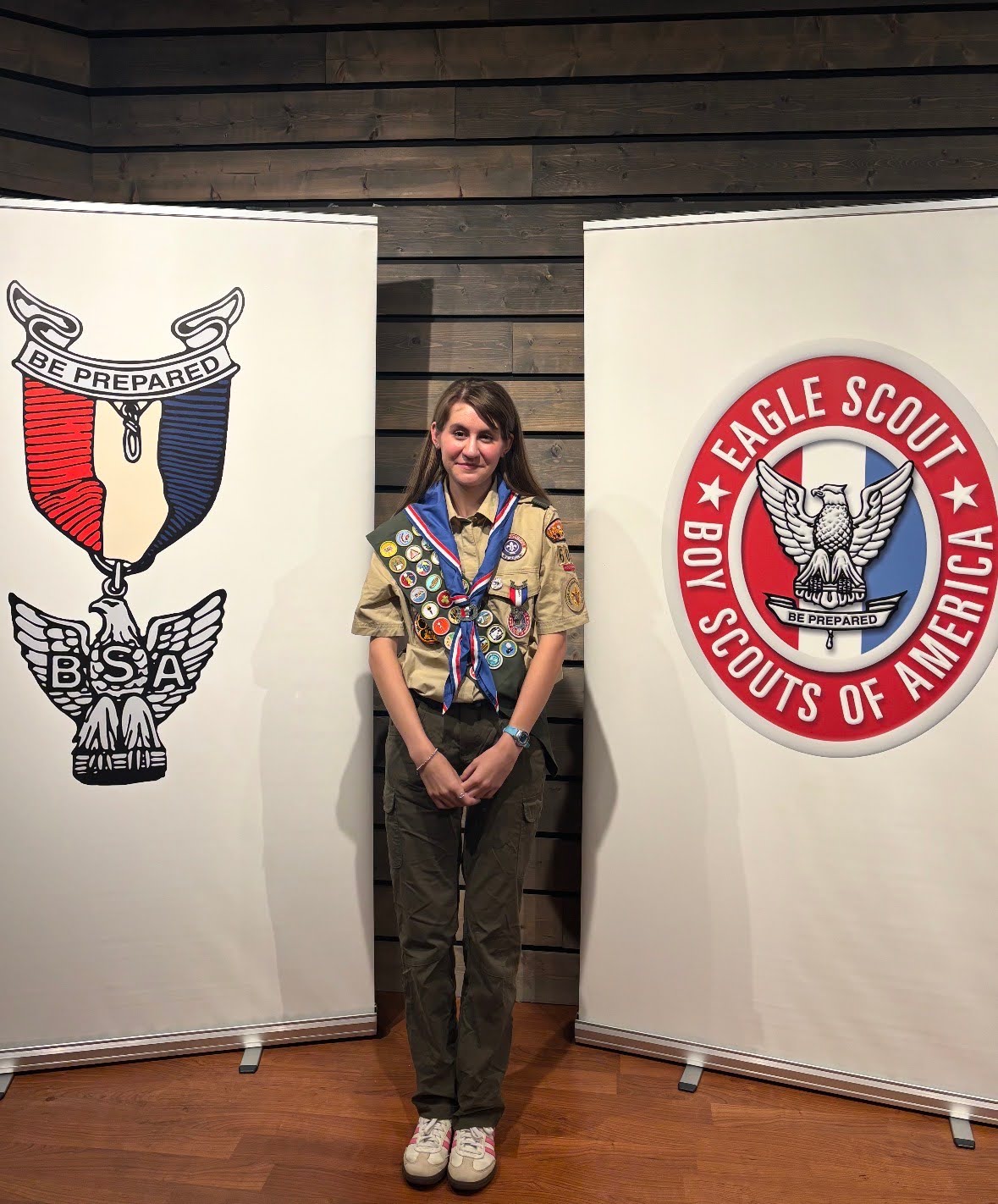
Amid discussions about whether the Pentagon should cut ties with Scouting America over the inclusion of girls, the future of young women in Scouts BSA (formerly the Boy Scouts of America) remains uncertain. Between potential changes in federal support, cultural backlash, and concerns over unadapted programming, girls’ access to Scouts hangs in the balance. Now more than ever, young women deserve the opportunity to remain in Scouts BSA, which they have been officially allowed to join since 2019.
I joined Scouts BSA as a shy and quiet 12 year old, and the experience turned me into an 18 year old ready to take on any challenge. As someone who spent six years in Scouts, I can say with certainty that the experience made me the person I am today. I learned to be confident, empathetic, and a good leader, all while surviving in the wilderness, leading meetings, and earning merit badges. Skills, especially those learned there, are not gendered. They need to be accessible to everyone—not just boys.
I'll never forget earning the rank of Eagle Scout, the highest and most prestigious status in Scouts BSA, in December of my junior year; having my Scoutmaster shake my hand and say to me, “I’m grateful my daughter has you as a role model.”
I now reflect on my time with the program as an alum, having aged out of my troop when I turned 18. To me, it’s about growing as a person, as a leader, and it means showing younger girls that they are resilient and should never feel they do not belong in a particular space, especially in those that are male-dominated.
Proving my affiliation in this male-dominated space hasn’t always been easy. I've had people tell me to quit, that I'd never be strong enough to backpack Philmont (Scouts BSA’s largest National High Adventure Base), that I should've just stayed home, or that I would never be able to succeed as men could.
These personal oppositions mirror a larger, systemic claim that allowing girls into Scouts BSA means female Scouts are infiltrating male spaces. In reality, most girls in Scouts belong to single-gender troops. While they are part of the larger Scouts BSA institution, they learn and grow in their own all-girls units. Yes, some girls belong to boys' troops—but in most cases, that is because there is no all-female unit for them to join. The solution to maintaining this "traditionally male” space is actually by making Scouting more accessible to girls, not less. When there are more spaces for girls, they do not have to join a boys’ troop just to have the Scouting experience.
While girls' troops may have what is commonly referred to as a "brother troop," they have their own guidance, their own structure, and their own meetings and activities. “Linked troops” are pairs of single-gender troops—a brother troop and a sister troop—that are chartered by the same organization and share a single troop committee. Boys' troops are not being overtaken or replaced. They simply coexist next to girls.
Critics even claim that co-ed spaces "pit girls against each other," rationalizing their goal of male exclusivity. In my experience, this sexist belief could not be further from the truth. In my troop, I was surrounded by girls who stood up for, supported, and pushed one another to new heights. We were and are welcoming, hardworking, and a group of women who fostered one of the best communities I have ever been a part of. Being surrounded by so many amazing women taught me how capable and strong I truly am.
There is also the counterargument that girls do not need to join Scouts BSA, as they have their own organization to join: Girl Scouts. The reality is that the two programs offer entirely different experiences, and kids should have the opportunity to join whichever fits them best. As someone who spent significant time in the Girl Scouts, I had no problem with it—I just found that Scouts BSA catered to my interests better, given its youth-led structure, advancement system, and outdoors opportunities such as High Adventure programs (I once spent a week in the Appalachian Mountains!).
At its core, Scouts BSA is about preparing the young men and women of America to become capable and ethical leaders who care for their communities. If that's the goal, why should the program be limited to boys? Excluding girls will undermine the organization’s mission of building a next generation of strong, caring leaders, because the gender restriction would limit the benefits of the program to only half of the population.
In my experience, allowing girls into Scouts BSA has only improved the program. The girls I met have been dedicated, diligent, and compassionate, serving as role models for their peers. The “real world” everyone is inevitably thrown into is not separated by gender. So why would Scouts be?
Scouts BSA did not make me less of a girl. It made me more prepared for the world. I learned how to pitch tents, cook food for my whole troop in pouring rain, and use a compass to lead us in the right direction on hikes (most of the time). I also learned about personal finance, what it meant to be a citizen of my community and nation, and even what to do in the event of a nuclear disaster. I learned that sometimes, you just have to rub some dirt on it. My identity as a girl never changed.
And that was never the point. I didn't join Scouts to take over boys' spaces. I joined Scouts BSA because I wanted to spend time outdoors and be in a group of girls having fun.
Today, I realize that this experience equipped me with the skills for success and taught me to navigate the world with confidence and kindness. That's an experience that every girl deserves, even if they get muddy while doing it. So I beg, let girls stay—where they belong—in Scouts BSA.



Sarina Weinberg • Mar 26, 2026 at 11:46 pm
Amazing article, Ava! You are such an empowering writer and friend. I was the proudest to hear you and your troop memebers reflect on your impact on your troop at your Court of Honor. I am so happy to hear that Scouts shaped you into someone I am giddy to call my best friend. I hope your words reach a wider audience, because this issue is not limited to Scouts. Thank you for sharing!
Laurie Nelson • Mar 26, 2026 at 10:24 pm
Proud of you Ava!
Ellen Cassidy • Mar 10, 2026 at 8:38 pm
Thank you for sharing this experience, Ava!
Michelle Renee Cadwell • Mar 10, 2026 at 1:53 pm
We have a 1st Ds in Cub scouts. Our 5yo DD in TK is ready to join her coed pack start of the school year. We couldn’t agree more that in the Den’s they are trying new things and its family oriented. I am doing events with the kids I wouldn’t have been able to do on my own. You are a role model!
Ava Nelson • Mar 26, 2026 at 9:54 pm
Thank you so much for the kind words! I am so glad your family is having a great Scouting experience, it truly is so special.